03 · Oral & maxillofacial surgery
All-on-4 immediate full arch: fixed teeth on implants
When all or nearly all the teeth in an arch are missing, you don't need one implant per tooth: a complete fixed arch, the hybrid prosthesis or All-on-4, is screwed onto four or six implants. Before surgery I measure the bone on a CT scan and design the prosthesis; during surgery I measure how firmly each implant sits. If they're stable, you leave with fixed provisional teeth; if not, we wait for the bone to integrate them.
After surgery, message me or call the office if bleeding doesn't stop with pressure from gauze, if you have a fever, if swelling or pain gets worse instead of better, or if the provisional comes loose or breaks. If you have trouble breathing or swallowing, go to the emergency room.
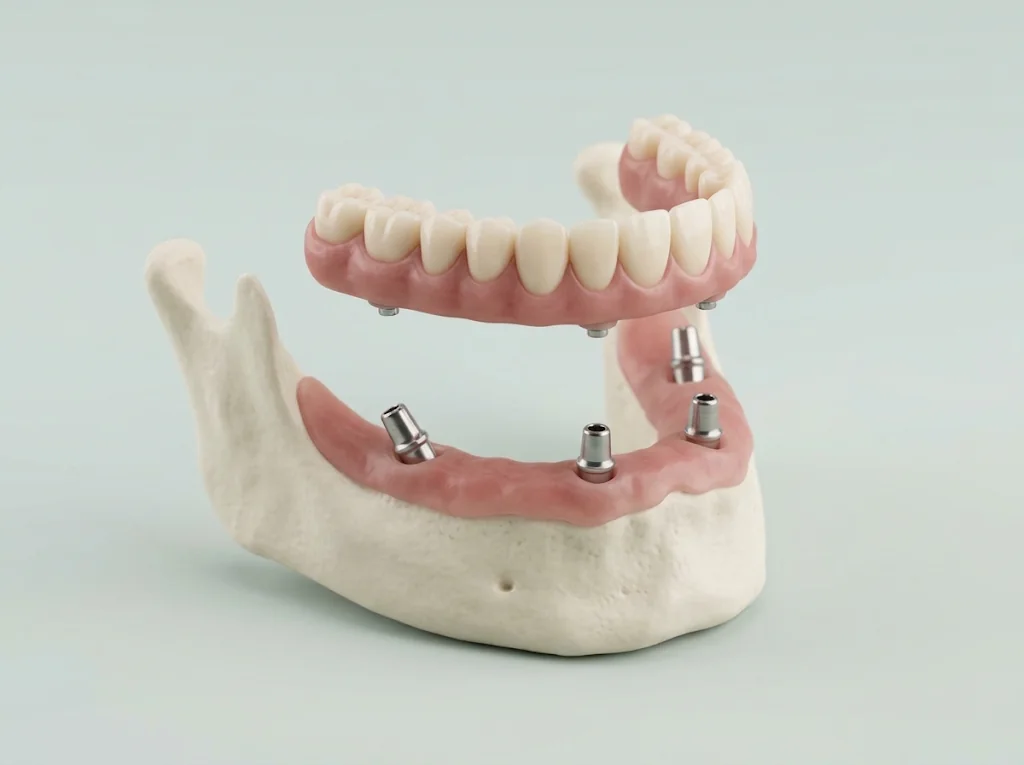
- Imaging
- 3D CT scan (CBCT)
- Implants per arch
- 4 or 6, depending on bone
- Fixed provisional
- Only if the implants are stable
- Final prosthesis
- Once the bone integrates the implants
When it's indicated
- You've lost all or nearly all of the teeth in one or both arches.
- Your denture moves, hurts or keeps you from eating.
- Your remaining teeth have a poor prognosis and you want fixed teeth.
- You've been told there's no bone in the back: tilting the back implants can avoid a graft.
Before surgery
- If you already have a recent CT scan or panoramic X-ray, bring it to the consultation.
- Tell me about your health conditions, your medications (especially for your bones) and any radiation to the head or neck: they change the plan.
- If you have diabetes or might have it, we order an HbA1c test to catch poor control and adjust it before surgery.
- If you smoke, quit: in smokers, the risk of having an early implant failure was double that of non-smokers, counted per patient.
- If you're having sedation, come with someone and don't drive that day.
How I plan it
How I do it
- 01ConsultationAt Hospital CIMA I examine your mouth, your imaging and your health, and explain whether All-on-4 suits you or what other option there is.
- 02Plan and quoteI define how many implants and where, the provisional, the timeline and the cost of each phase. There are two parts, surgery and prosthesis: I tell you who does each one.
- 03SurgeryUnder local anesthesia and, depending on the case, sedation. I remove the teeth that can't be saved and place the implants in the planned positions.
- 04ProvisionalIf there's stability, a fixed provisional is screwed in; in one review, 1,201 fixed prostheses were placed within 48 hours after surgery. If not, you wear a removable one while the bone integrates the implants.
- 05Final prosthesisAfter a few months of integration and check-ups, new records are taken and the final, stronger prosthesis is placed.
Recovery
- First 72 hours: this may be when pain control matters most; in trials, anti-inflammatory drugs reduced pain compared with placebo. For swelling, cold packs.
- Soft foods throughout the provisional phase: the provisional is the piece that breaks most; in an upper-jaw series, mechanical complications were 58.8% with the provisional and 7.3% with the final prosthesis.
- Gentle hygiene from day one and, later, a water flosser and interdental brushes under the prosthesis. No smoking.
- The first year is key: in one review, 74% of implant failures happened within the first 12 months. Don't miss those check-ups.
- For life, professional check-ups and cleanings: people who attend regularly have a lower risk of disease around their implants.
Risks and how I prevent them
- Losing an implant
- An overview of reviews reports cumulative survival of 94.8% to 99.3%, depending on the included review; in a systematic review, at 5 years or more, 98.14% of implants were still in place with four and 97.50% with six. Smoking was associated with more implant loss. Prevention: CT scan, measured stability and check-ups in the first year. If one fails, depending on the case a new one is placed and the prosthesis is adapted.
- Fractures or loose screws
- Mechanical complications range from 5.91% (systematic review) to 36.7% (series of up to 18 years), mostly with the provisional. In another review, the main one was fracture of the all-acrylic prosthesis; zirconia may reduce them. Prevention: soft foods, the right material and a night guard if you clench. They're repaired or adjusted.
- Inflammation or bone loss around the implants
- Biological complications were 6.54% in the systematic review and affected 11.8% of implants in the lower-jaw series. Prevention: daily cleaning under the prosthesis, maintenance, controlled diabetes and not smoking. If they appear, professional cleaning and peri-implantitis treatment.
- Not being able to load right away
- That isn't a failure: in well-selected cases, immediate, early and conventional loading had similar survival; implant survival was estimated above 99% at one year. Meanwhile, you wear a removable prosthesis.
- Nerve or sinus injury
- I locate both on the CT scan before planning. If numbness of the lip or chin lasts after the anesthesia has worn off, or you have sinus symptoms, let me know right away.
Other options
- Keeping a full denture
- Not having surgery is valid if there are medical risks or you don't want surgery. I also adjust upper and lower full dentures.
- Implant overdenture
- It's removable and clips onto implants. In the upper jaw, an overview of systematic reviews advises against resting it on fewer than four implants.
- Keeping the teeth that can be saved
- They're treated and only the missing teeth are replaced, with single implants, bridges or a partial denture.
- Bone grafts or zygomatic implants
- When there isn't bone even for four implants. Zygomatic implants, anchored in the cheekbone, are often indicated as an alternative to major graft reconstructions.
Frequently asked questions
How much does All-on-4 cost in Costa Rica?
I don't publish a single price: it depends on one arch or both, four or six implants, whether extractions or grafts are needed and the prosthesis material. A consultation is ₡60,000 and a video consultation ₡20,000. With your CT scan I give you the cost of each phase. You can pay by credit card, debit card or cash.
Four implants or six?
It depends on the bone, the arch and how strong your bite is. In the upper jaw, an overview of systematic reviews advises against using fewer than four. At 5 years or more, survival was high with both options.
Will I leave with fixed teeth the same day?
If the implants are stable, a fixed provisional is screwed in within the first hours or days: the torque I measure decides it, not the calendar. If it isn't enough, we wait for the bone to integrate them.
What is the final prosthesis made of?
There's no single material: it's chosen for your case. The provisional is replaced by the final one once the bone has integrated the implants. What studies show: in one review, the main prosthetic complication was fracture of the all-acrylic prosthesis, and according to a systematic review, zirconia may reduce mechanical complications.
How do I clean it, and how often are check-ups?
It's screwed in: you don't take it out at home. You clean it daily, underneath too, with interdental brushes and a water flosser. The European Federation of Periodontology guideline recommends maintenance with periodic check-ups; the frequency depends on your case.
What if I've been told I don't have enough bone?
First it's measured on the CT scan. Tilting the back implants uses the bone in the front, and an overview of systematic reviews found no difference in failure between tilted and straight implants. If that isn't enough, we consider bone grafts or zygomatic implants.
How long does a hybrid prosthesis last?
No number predicts your case. Two long-term series from the center that created the technique report: in the lower jaw, with up to 18 years, 98.8% of prostheses and 93% of implants were still in place; in the upper jaw, with up to 13 years, 94.7% of implants. Some patients didn't complete follow-up. What depends most on you: not smoking, hygiene and check-ups.
Sources
- 1.Shao WH et al. — All-on-4 and All-on-6 implant-supported fixed prostheses for the edentulous jaw: a systematic review and meta-analysis. Int J Oral Maxillofac Surg, 2026.
- 2.Figueiredo CE et al. — Rehabilitation of edentulous jaws using the "All-on-Four" treatment concept: an overview of systematic reviews. Oral Maxillofac Surg, 2025.
- 3.Patzelt SB et al. — The all-on-four treatment concept: a systematic review. Clin Implant Dent Relat Res, 2014.
- 4.Maló P et al. — The All-on-4 treatment concept for the rehabilitation of the completely edentulous mandible: A longitudinal study with 10 to 18 years of follow-up. Clin Implant Dent Relat Res, 2019.
- 5.Maló P et al. — The All-on-4 concept for full-arch rehabilitation of the edentulous maxillae: A longitudinal study with 5-13 years of follow-up. Clin Implant Dent Relat Res, 2019.
- 6.Kwon T et al. — Systematic review of short- (5-10 years) and long-term (10 years or more) survival and success of full-arch fixed dental hybrid prostheses and supporting implants. J Dent, 2014.
- 7.Papaspyridakos P et al. — Implant loading protocols for edentulous patients with fixed prostheses: a systematic review and meta-analysis. Int J Oral Maxillofac Implants, 2014.
- 8.Messias A et al. — Different Interventions for Rehabilitation of the Edentulous Maxilla with Implant-Supported Prostheses: An Overview of Systematic Reviews. Int J Prosthodont, 2021.
- 9.Malak AA et al. — Implant Failure and Marginal Bone Loss Between Axial and Tilted Implants: An Umbrella Review with Meta-analysis. Int J Oral Maxillofac Implants, 2024.
- 10.Tyndall DA et al. — Position statement of the American Academy of Oral and Maxillofacial Radiology on selection criteria for the use of radiology in dental implantology with emphasis on cone beam computed tomography. Oral Surg Oral Med Oral Pathol Oral Radiol, 2012.
- 11.Khouly I et al. — Post-operative pain management in dental implant surgery: a systematic review and meta-analysis of randomized clinical trials. Clin Oral Investig, 2021.
- 12.Fan YY et al. — Smoking in relation to early dental implant failure: A systematic review and meta-analysis. J Dent, 2024.
- 13.Bencze B et al. — Prediabetes and poorly controlled type-2 diabetes as risk indicators for peri-implant diseases:A systematic review and meta-analysis. J Dent, 2024.
- 14.Herrera D et al. — Prevention and treatment of peri-implant diseases-The EFP S3 level clinical practice guideline. J Clin Periodontol, 2023.
- 15.Carra MC et al. — Primordial and primary prevention of peri-implant diseases: A systematic review and meta-analysis. J Clin Periodontol, 2023.
- 16.Moraschini V et al. — Survival and complications of zygomatic implants compared to conventional implants reported in longitudinal studies with a follow-up period of at least 5 years: A systematic review and meta-analysis. Clin Implant Dent Relat Res, 2023.
Reviews from my patients (not necessarily about this procedure)
«Desde que entramos al área de parqueo se siente la seguridad y confianza, la recepcionista muy amable y simpática, poco antes de la hora de la cita nos avisan que había un pequeño atraso por una complicación con el paciente que tenía el Dr. Torres en ese momento la espera no fue larga y de todos modos el área de espera es muy amplia y agradable, El Dr. Torres muy amable y profesional en todo momento, no escatimó tiempo para dar una amplia explicación del procedimiento, en general mi esposa y yo nos sentimos muy cómodos y sobretodo con mucha confianza de estar en las manos adecuadas.Definitivamente 100% recomendados !»«El Doctor Ronald Torres es un excelente profesional. Lo recomiendo 100%. Su trato siempre ha sido amable, cortes, profesional. Se interesa en comprender la necesidad del paciente, y en todo momento trata que este comprenda bien los alcances del procedimiento a realizar. Ya me ha extraido dos cordales, y puedo decir que me fue muy bien. Puede tener confianza de buscar al Dr. Ronald, que le aseguro quedara satisfecho con su atencion.»«Excelente profesional, impecable en la técnica de su especialidad y con un trato humano digno de resaltar. Desde el día uno nos sentimos cómodos con él y esto se mantuvo y se ha mantenido hasta el día de hoy, en donde estamos ya con citas de mero seguimiento. La intervención quirúrgica realizada fue un éxito y el costo muy razonable. La verdad que gracias a Dios tomamos una excelente decisión con él. Súper recomendado.»«Mi hijo Luis Guillermo se realizó una cirugía maxilofacial con el doctor Torres y su equipo, el resultado fue y es a hoy excelente, recibió un servicio excelente de seguimiento después de su cirugía.Le cambió mucho la vida a mi hijo de forma positiva , una gran inyección de seguridad y autoestima.Como padres nos sentimos muy agradecidos y es de esas inversiones que valen la pena .»Other procedures
- 01Wisdom teeth surgery
- 02Dental implants
- 04Orthognathic surgery
- 05Sinus lift
- 06TMJ treatment and surgery
- 07Facial trauma
- 08Jaw cysts and tumors
- 09Buccal fat removal
- 10Extractions and abscesses
- 11Bone grafting and socket preservation
- 12Oral lesions and biopsy
- 13Zygomatic implants
- 14Video consultation and second opinion