13 · Oral & maxillofacial surgery
Dental implants when there is no bone: zygomatic implants in Costa Rica
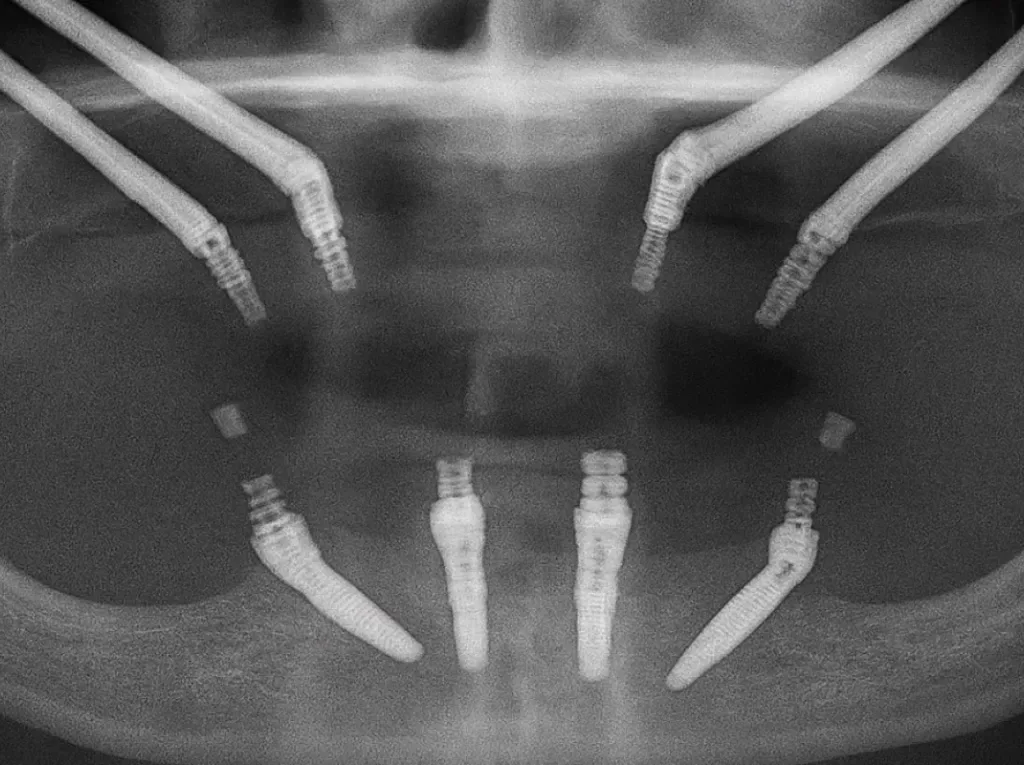
If you were told you don't have enough bone for upper implants, there may still be options. When the upper jaw has lost so much bone that a conventional implant won't fit without major grafting, zygomatic implants anchor in the cheekbone and can support fixed teeth. They aren't for everyone: first I measure on a CT scan how much bone is left. I am an oral and maxillofacial surgeon (specialty at UNAM, 2013), certified by the Mexican Board of Oral and Maxillofacial Surgery and a professor at the University of Costa Rica since 2006; I see patients in Tower 1 of Hospital CIMA.
After surgery, if you have double vision, pain or swelling in the eye, fever, bleeding that won't stop or swelling that keeps growing, go to the emergency room right away. If liquids come out of your nose or the temporary teeth move, message me or call the office.
- Who it's for
- Upper jaw with advanced bone loss
- Imaging
- 3D CT scan (CBCT) of the face
- Temporary teeth
- Fixed within days, if the implants are stable
- Consultation
- 60,000 colones · by video, 20,000
When it's indicated
- The CT scan shows advanced resorption: a conventional implant won't fit without major grafts.
- Previous bone grafts or implants have failed.
- You want to avoid staged grafting, which stretches treatment over months; if the implants are stable, fixed teeth arrive within days.
- Part of the upper jaw is missing after a tumor, trauma or a birth defect; then radiation therapy and control of the disease also weigh in.
Before surgery
- If you already have a CT scan, send it to me; we can review it first by video.
- Bring a list of your medications and tell me if you take or have taken bone medications (for osteoporosis or cancer) or had radiation therapy to the head and neck: they change the plan.
- If you smoke, stop: across 107 studies, 6.35% of implants failed in smokers versus 3.18% in non-smokers.
- Congestion, discharge or facial pain: tell me; a sinus problem is treated before surgery.
- Diabetes or another chronic condition: under control, with your doctor. For surgery, fast as my written instructions say and come with someone.
How I plan it
How I do it
- 01ConsultationI review your CT scan, health and medications, and tell you whether a zygomatic implant is your option.
- 02AnesthesiaGeneral, or sedation with local anesthesia, depending on the case; we decide together.
- 03PlacementEach zygomatic implant goes through the upper jaw and anchors in the cheekbone, together with the implants in front if there are any. I use the CT scan as the map and operate with a direct view of the field to protect the eye socket.
- 04Temporary teethIf the implants are stable, a fixed temporary is screwed in within hours or days; if not, we wait for the bone to integrate them. I know during surgery, not before.
- 05Final prosthesisMonths later, the temporary is replaced with the final one; in the randomized trial comparing zygomatic implants with grafting, it was at 4 months.
Recovery
- The first few days are the hardest: swelling and bruising on the cheek, discomfort and, sometimes, a little bleeding from the nose.
- In the randomized trial, people who received zygomatic implants reported on average 7.17 days of total and 12.17 days of partial impaired activity.
- Soft food while you heal and while you wear the temporary teeth, with written instructions.
- The first year may carry more risk of losing an implant (2% that year versus 0.5% per year after, according to the ITI consensus): that is why the first check-ups are more frequent.
- For life: hygiene, cleanings and check-ups; these implants may need more maintenance, have limits on chewing force, and sinusitis can appear years later.
Risks and how I prevent them
- Sinusitis
- The most reported complication: 2.4% in one large review and 14.2% at 5 years in another; it can appear years later. I prevent it by checking the sinuses first and choosing the implant path for your anatomy. It is treated with antibiotics or drainage surgery; if it does not respond, the implant may be lost.
- Cheek or lip numbness
- It involves the nerve that exits below the eye: 0.55% to 10.78% depending on the technique; fifteen publications report it as temporary. CT planning reduces it.
- Gum infection around the implant
- Between 2.0% and 7.50%, depending on the review and technique. It is prevented with hygiene and check-ups, and treated with cleaning, antibiotics or minor surgery.
- Opening between the mouth and the sinus
- Uncommon: 0.4% to 4.58% depending on the review and technique. If it happens, it is closed surgically.
- Eye socket injury
- Serious, without a reliable rate: the ITI consensus gathers four cases of orbital penetration in three studies. I plan on the CT scan and operate with a direct view; if there are eye symptoms, immediate care with an ophthalmologist.
- Fewer failures than grafting, but more complications
- In the randomized trial (71 patients), at one year 1 prosthesis failed or was not delivered with zygomatic implants versus 6 with grafting, but more patients had complications: 28 vs. 14. In the 4-month report, the zygomatic group's complications resolved on their own or could be managed. An overview of systematic reviews warns complications may be underestimated.
Other options
- Not operating
- Keeping a full denture, adjusted or remade, is valid, especially if there are medical risks or you don't want surgery.
- Bone grafting, then conventional implants
- According to the latest Cochrane review (a single trial for this comparison), zygomatic implants probably have fewer implant failures, but more complications. In that trial, fixed teeth arrived on average at 1.34 days with zygomatic implants and at 444.32 with grafting.
- If some bone is left
- Tilted implants (as in an All-on-4 hybrid prosthesis), short implants or a sinus lift, less invasive in borderline cases.
- Other graftless techniques
- Pterygoid, transnasal or custom subperiosteal implants, for very selected cases: I explain them at my dedicated practice.
Frequently asked questions
What should I do if I was told I don't have enough bone for implants?
Ask for it to be measured on a CT scan: sometimes it means there isn't enough for a conventional implant without a graft, not that there is no option. Send me the CT scan and I'll tell you what I see.
What is a zygomatic implant, and who is a candidate?
It is a longer implant that anchors in the cheekbone, so it only works for the upper jaw. It is for someone with advanced bone loss there, measured on a CT scan, or whose grafts or implants have failed. Extra care is needed if you smoke, have untreated sinusitis, receive high-dose bone medications for cancer or have had radiation therapy.
How long do zygomatic implants last?
No one can promise that. In studies with at least 3 years of follow-up, on average 96.2% of implants were still in place at 6 years; with 5 years or more, 96.5%, with no difference from conventional implants (95.8%). Hygiene, check-ups and not smoking all play a part.
What are the downsides of zygomatic implants?
It is a more complex surgery than a conventional implant, with its own risks —mainly sinusitis— and more maintenance. Compared with grafting, more complications but fewer failures.
How much do zygomatic implants cost in Costa Rica?
It depends on how many implants your case needs, the temporary and final prostheses and the anesthesia: I give you the exact quote after evaluating your CT scan. A consultation is 60,000 colones at the office and 20,000 by video.
Who performs the surgery?
I plan and lead it myself. It's worth asking: according to the ITI consensus, success in this surgery depends heavily on the surgeon's skill and experience. I am a member of the IAOMS and was a speaker at the AO CMF course "Advances in maxillo-mandibular reconstruction" (San José, 2014).
Sources
- 1.Brennand Roper M et al. — Long-term treatment outcomes with zygomatic implants: a systematic review and meta-analysis. Int J Implant Dent, 2023.
- 2.Moraschini V et al. — Survival and complications of zygomatic implants compared to conventional implants reported in longitudinal studies with a follow-up period of at least 5 years: A systematic review and meta-analysis. Clin Implant Dent Relat Res, 2023.
- 3.Al-Nawas B et al. — ITI consensus report on zygomatic implants: indications, evaluation of surgical techniques and long-term treatment outcomes. Int J Implant Dent, 2023.
- 4.Visconti RF et al. — Interventions for replacing missing teeth: zygomatic implants for the rehabilitation of the severely atrophic edentulous maxilla. Cochrane Database Syst Rev, 2026.
- 5.Davó R et al. — Immediately loaded zygomatic implants vs conventional dental implants in augmented atrophic maxillae: 1-year post-loading results from a multicentre randomised controlled trial. Eur J Oral Implantol, 2018.
- 6.Esposito M et al. — Immediately loaded zygomatic implants vs conventional dental implants in augmented atrophic maxillae: 4 months post-loading results from a multicentre randomised controlled trial. Eur J Oral Implantol, 2018.
- 7.Chrcanovic BR et al. — Survival and Complications of Zygomatic Implants: An Updated Systematic Review. J Oral Maxillofac Surg, 2016.
- 8.Kämmerer PW et al. — Evaluation of surgical techniques in survival rate and complications of zygomatic implants for the rehabilitation of the atrophic edentulous maxilla: a systematic review. Int J Implant Dent, 2023.
- 9.D'Ambrosio F et al. — Clinical Risk and Medico-Legal Implications in Zygomatic Implant Rehabilitation: An Umbrella Review of Systematic Reviews. Diagnostics (Basel), 2026.
- 10.Acerra A et al. — Zygomatic Implants for Rehabilitation of the Atrophic Maxilla: Clinical Indications, Outcomes, Complications, and Evidence Gaps-A Comprehensive Review. Medicina (Kaunas), 2026.
- 11.Chrcanovic BR et al. — Smoking and dental implants: A systematic review and meta-analysis. J Dent, 2015.
- 12.Schimmel M et al. — Effect of advanced age and/or systemic medical conditions on dental implant survival: A systematic review and meta-analysis. Clin Oral Implants Res, 2018.
Reviews from my patients (not necessarily about this procedure)
«Desde que entramos al área de parqueo se siente la seguridad y confianza, la recepcionista muy amable y simpática, poco antes de la hora de la cita nos avisan que había un pequeño atraso por una complicación con el paciente que tenía el Dr. Torres en ese momento la espera no fue larga y de todos modos el área de espera es muy amplia y agradable, El Dr. Torres muy amable y profesional en todo momento, no escatimó tiempo para dar una amplia explicación del procedimiento, en general mi esposa y yo nos sentimos muy cómodos y sobretodo con mucha confianza de estar en las manos adecuadas.Definitivamente 100% recomendados !»«El Doctor Ronald Torres es un excelente profesional. Lo recomiendo 100%. Su trato siempre ha sido amable, cortes, profesional. Se interesa en comprender la necesidad del paciente, y en todo momento trata que este comprenda bien los alcances del procedimiento a realizar. Ya me ha extraido dos cordales, y puedo decir que me fue muy bien. Puede tener confianza de buscar al Dr. Ronald, que le aseguro quedara satisfecho con su atencion.»«Excelente profesional, impecable en la técnica de su especialidad y con un trato humano digno de resaltar. Desde el día uno nos sentimos cómodos con él y esto se mantuvo y se ha mantenido hasta el día de hoy, en donde estamos ya con citas de mero seguimiento. La intervención quirúrgica realizada fue un éxito y el costo muy razonable. La verdad que gracias a Dios tomamos una excelente decisión con él. Súper recomendado.»«Mi hijo Luis Guillermo se realizó una cirugía maxilofacial con el doctor Torres y su equipo, el resultado fue y es a hoy excelente, recibió un servicio excelente de seguimiento después de su cirugía.Le cambió mucho la vida a mi hijo de forma positiva , una gran inyección de seguridad y autoestima.Como padres nos sentimos muy agradecidos y es de esas inversiones que valen la pena .»Other procedures
- 01Wisdom teeth surgery
- 02Dental implants
- 03All-on-4 immediate full arch
- 04Orthognathic surgery
- 05Sinus lift
- 06TMJ treatment and surgery
- 07Facial trauma
- 08Jaw cysts and tumors
- 09Buccal fat removal
- 10Extractions and abscesses
- 11Bone grafting and socket preservation
- 12Oral lesions and biopsy
- 14Video consultation and second opinion