02 · Oral & maxillofacial surgery
Dental implants planned by an oral and maxillofacial surgeon
An implant is a titanium root that fuses with the bone and holds a new tooth. My part is the surgery: measuring the bone on the CT scan, placing the implant where the tooth needs it, and protecting the bone and gum around it. Your dentist or prosthodontist makes the crown, working from the same plan.
Message or call me right away if bleeding doesn't stop with firm pressure, if you have a fever, pus or swelling that grows instead of going down, or if your lip stays numb after the anesthesia wears off. If you can't reach me, go to the emergency room.
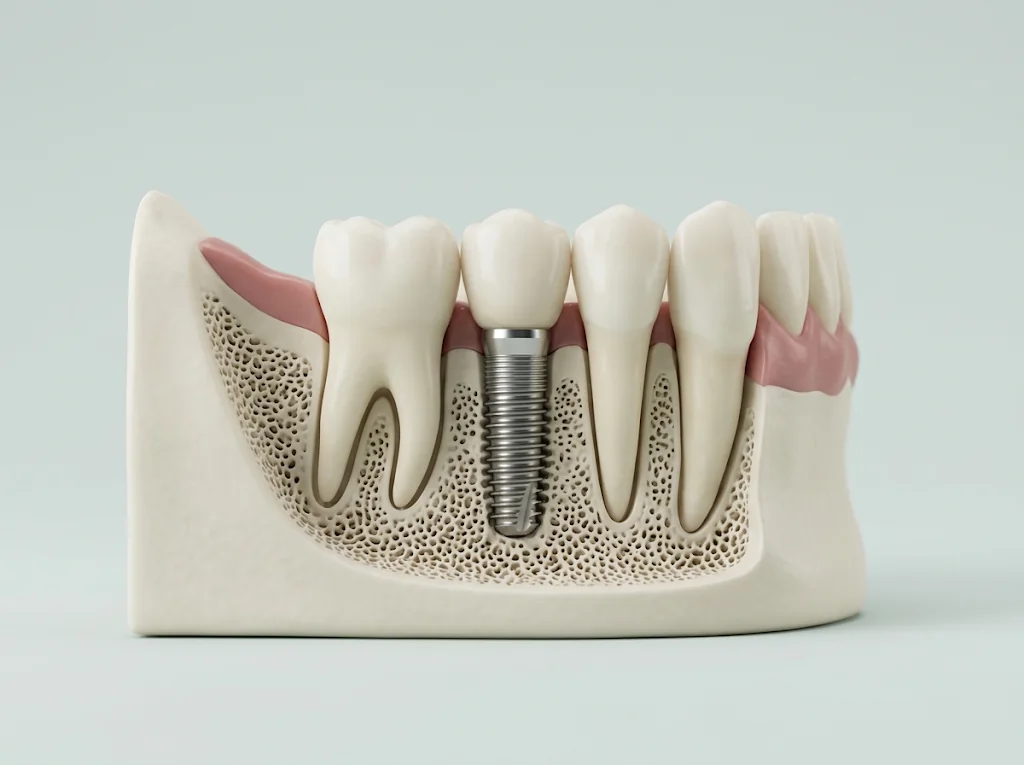
- Anesthesia
- Local; sedation if needed
- Imaging
- Cone beam CT (CBCT)
- Still in place at 10 years
- 93.2% to 96.4% in studies
- Crown
- Made by your dentist or prosthodontist
When it's indicated
- You're missing one or more teeth and want something fixed, without grinding down neighboring teeth.
- A tooth can't be saved: it makes sense to plan the implant before it comes out.
- Your removable denture moves, hurts or keeps you from chewing.
- The bone thinned after an old extraction and we need to measure if there's enough.
- The bone ridge was left uneven and needs smoothing before a prosthesis (alveoloplasty).
Before surgery
- If you already have a recent CT scan or panoramic X-ray, bring it: it sometimes saves a repeat scan.
- Bring a list of your medications and don't stop any on your own. If you take bisphosphonates or denosumab for osteoporosis, an international expert task force suggests they don't need to be stopped before an implant (a weak recommendation); we discuss the risk.
- If you have or might have diabetes, I'll ask for an HbA1c test: poorly controlled diabetes was linked to more bone loss around the implant, so it's worth adjusting it first.
- Gum disease and cavities are treated first. And if you smoke, now is the time to quit.
- If the plan includes sedation, I give you written fasting instructions and you'll need someone to take you home.
How I plan it
How I do it
- 01Consultation and planI review your history, mouth and CT scan, explain the options — with and without an implant — and settle with your dentist the crown, the number of implants and whether a graft is needed.
- 02Careful extractionIf the tooth is still there, I remove it while protecting the socket, the bone that will hold the implant. If conditions allow, the implant goes in that same day; if not, I fill the socket with graft to reduce bone shrinkage. I teach this: in 2018 I gave a talk on atraumatic extraction and socket preservation at the National Autonomous University of Honduras.
- 03PlacementUnder local anesthesia, I place the implant in the planned position. It stays under the gum or with a healing cap.
- 04IntegrationOver months the bone fuses with the implant. The timing depends on the bone and any graft; I check it before green-lighting the crown.
- 05Crown and maintenanceYour dentist places the crown. After that, a programme of regular check-ups and cleanings, as the European Federation of Periodontology's guideline recommends.
Recovery
- First 72 hours: possibly when pain control matters most. Take the pain reliever I prescribe on schedule from the start, not once it hurts.
- First days: some swelling, bruising or light bleeding. Cold packs, soft food on the other side, gentle cleaning and no smoking.
- A follow-up visit to check the area and remove stitches if needed.
- Following months: the bone integrates. If you have a provisional tooth, don't bite hard on it.
- For life: regular check-ups were linked to less disease around the implant and, it appears, a lower risk of losing it.
Risks and how I prevent them
- It doesn't integrate (early failure)
- In smokers, the risk of early failure was double that of non-smokers, especially in the upper jaw. To lower that risk: a CT scan, no tobacco and, when indicated, a single antibiotic dose, which reduced failures in the Cochrane review. If it happens, I remove the implant and, once healed, we consider another.
- Peri-implantitis
- Inflammation with bone loss around the implant: between 21% and 25.0% of patients, depending on the review; in non-smokers, 5.2% of implants. It's linked to periodontitis, diabetes, smoking and alcohol. Healthy gums, controlled diabetes and maintenance help prevent it. Treatment: deep cleaning or, if it progresses, surgery.
- Injury to a nerve, the sinus or a neighboring tooth
- The CT scan and safety margin are there to reduce that risk. If your lip or chin stays numb after the anesthesia wears off, tell me right away.
- Osteonecrosis with bone medications
- In people with osteoporosis on antiresorptive drugs, it was reported in 0.5% after an implant. It's low but real: we discuss it and I watch for it. With cancer-treatment doses the evaluation is different.
- Crown or screw problems
- A screw can loosen or a part can fracture. Good design and check-ups help prevent it; it's adjusted or repaired.
Other options
- Fixed bridge
- It rests on the neighboring teeth, which have to be ground down. It makes sense if they already need crowns.
- Removable denture
- No surgery. It moves more than an implant and comes out for cleaning.
- Not replacing the tooth
- Sometimes valid, as with some back molars. The bone there tends to thin, though.
- Short implant instead of a graft
- In upper back teeth with little bone, eight randomized trials found no significant difference in failures between short implants (8 mm or less) and standard implants with a sinus lift; in a Cochrane review, the sinus lift had more complications.
Frequently asked questions
How much does a dental implant cost in Costa Rica?
It depends on the number of implants, whether a graft is needed and what imaging you already have, so I don't publish a surgery price. Your dentist quotes the crown. A consultation is ₡60,000 and a video consultation ₡20,000; once I see your imaging, I give you the surgical quote.
How long does the whole process take?
Months, not weeks: the bone has to integrate, and a graft beforehand adds time. Sometimes a provisional tooth goes in the same day, if the implant is firm and your bite allows it; I decide during surgery.
Does getting an implant hurt?
Local anesthesia is there so you don't feel pain during surgery; you will feel pressure. Afterwards there's discomfort for a few days, managed with medication.
What if I don't have enough bone?
Depending on the case, bone is rebuilt with grafts, the sinus lifted, or short implants used. If the upper jaw has lost a lot of bone, zygomatic implants, anchored in the cheekbone, are often indicated instead of major reconstructions.
How long does an implant last?
In studies of 10 to 25 years, approximately 95% of implants were still in place. But staying in place isn't the same as being healthy: hygiene, check-ups and not smoking protect it. I don't promise a time frame.
Can I get implants if I have diabetes or smoke?
In many cases, yes. Well-controlled type 2 diabetes was not linked to more disease around the implant. Smoking doesn't rule implants out by itself, but it raises the risk of failure and bone loss.
Which brand do you use, and is there a guarantee?
I confirm the brand and the terms of treatment at the consultation, with the quote. What no one can promise is how your bone will respond: that's why I plan, explain the risks and follow up with you.
Sources
- 1.Howe MS et al. — Long-term (10-year) dental implant survival: A systematic review and sensitivity meta-analysis. J Dent, 2019.
- 2.Moraschini V et al. — Ten years and beyond: Long-term dental implant survival, success, and biological health-A systematic review and meta-analysis. Periodontol 2000, 2026.
- 3.Tyndall DA et al. — Position statement of the American Academy of Oral and Maxillofacial Radiology on selection criteria for the use of radiology in dental implantology with emphasis on cone beam computed tomography. Oral Surg Oral Med Oral Pathol Oral Radiol, 2012.
- 4.Tahmaseb A et al. — The accuracy of static computer-aided implant surgery: A systematic review and meta-analysis. Clin Oral Implants Res, 2018.
- 5.Tan WL et al. — A systematic review of post-extractional alveolar hard and soft tissue dimensional changes in humans. Clin Oral Implants Res, 2012.
- 6.Avila-Ortiz G et al. — Effect of alveolar ridge preservation interventions following tooth extraction: A systematic review and meta-analysis. J Clin Periodontol, 2019.
- 7.Herrera D et al. — Prevention and treatment of peri-implant diseases-The EFP S3 level clinical practice guideline. J Clin Periodontol, 2023.
- 8.Carra MC et al. — Primordial and primary prevention of peri-implant diseases: A systematic review and meta-analysis. J Clin Periodontol, 2023.
- 9.Khouly I et al. — Post-operative pain management in dental implant surgery: a systematic review and meta-analysis of randomized clinical trials. Clin Oral Investig, 2021.
- 10.Fan YY et al. — Smoking in relation to early dental implant failure: A systematic review and meta-analysis. J Dent, 2024.
- 11.Calciolari E et al. — Tobacco Smoking and Smoke-Free Products as Risk Factors for Dental Implants: A Systematic Review. Clin Oral Implants Res, 2026.
- 12.Esposito M et al. — Interventions for replacing missing teeth: antibiotics at dental implant placement to prevent complications. Cochrane Database Syst Rev, 2013.
- 13.Reis INRD et al. — The prevalence of peri-implant mucositis and peri-implantitis based on the world workshop criteria: A systematic review and meta-analysis. J Dent, 2025.
- 14.Galarraga-Vinueza ME et al. — Prevalence, incidence, systemic, behavioral, and patient-related risk factors and indicators for peri-implant diseases: An AO/AAP systematic review and meta-analysis. J Periodontol, 2025.
- 15.Bencze B et al. — Prediabetes and poorly controlled type-2 diabetes as risk indicators for peri-implant diseases:A systematic review and meta-analysis. J Dent, 2024.
- 16.Ali DS et al. — Antiresorptive Therapy to Reduce Fracture Risk and Effects on Dental Implant Outcomes in Patients With Osteoporosis: A Systematic Review and Osteonecrosis of the Jaw Taskforce Consensus Statement. Endocr Pract, 2025.
- 17.Mirza R et al. — Dental Implant Failure and Medication-Related Osteonecrosis of the Jaw Related to Dental Implants in Patients Taking Antiresorptive Therapy for Osteoporosis: A Systematic Review and Meta-Analysis. Endocr Pract, 2025.
- 18.Wang C et al. — Short implants (≤ 8 mm) versus standard implants with sinus floor elevation in the atrophic posterior maxilla: A systematic review and meta-analysis of randomized controlled trials. J Stomatol Oral Maxillofac Surg, 2026.
- 19.Esposito M et al. — Interventions for replacing missing teeth: augmentation procedures of the maxillary sinus. Cochrane Database Syst Rev, 2014.
- 20.Moraschini V et al. — Survival and complications of zygomatic implants compared to conventional implants reported in longitudinal studies with a follow-up period of at least 5 years: A systematic review and meta-analysis. Clin Implant Dent Relat Res, 2023.
Reviews from my patients (not necessarily about this procedure)
«Desde que entramos al área de parqueo se siente la seguridad y confianza, la recepcionista muy amable y simpática, poco antes de la hora de la cita nos avisan que había un pequeño atraso por una complicación con el paciente que tenía el Dr. Torres en ese momento la espera no fue larga y de todos modos el área de espera es muy amplia y agradable, El Dr. Torres muy amable y profesional en todo momento, no escatimó tiempo para dar una amplia explicación del procedimiento, en general mi esposa y yo nos sentimos muy cómodos y sobretodo con mucha confianza de estar en las manos adecuadas.Definitivamente 100% recomendados !»«El Doctor Ronald Torres es un excelente profesional. Lo recomiendo 100%. Su trato siempre ha sido amable, cortes, profesional. Se interesa en comprender la necesidad del paciente, y en todo momento trata que este comprenda bien los alcances del procedimiento a realizar. Ya me ha extraido dos cordales, y puedo decir que me fue muy bien. Puede tener confianza de buscar al Dr. Ronald, que le aseguro quedara satisfecho con su atencion.»«Excelente profesional, impecable en la técnica de su especialidad y con un trato humano digno de resaltar. Desde el día uno nos sentimos cómodos con él y esto se mantuvo y se ha mantenido hasta el día de hoy, en donde estamos ya con citas de mero seguimiento. La intervención quirúrgica realizada fue un éxito y el costo muy razonable. La verdad que gracias a Dios tomamos una excelente decisión con él. Súper recomendado.»«Mi hijo Luis Guillermo se realizó una cirugía maxilofacial con el doctor Torres y su equipo, el resultado fue y es a hoy excelente, recibió un servicio excelente de seguimiento después de su cirugía.Le cambió mucho la vida a mi hijo de forma positiva , una gran inyección de seguridad y autoestima.Como padres nos sentimos muy agradecidos y es de esas inversiones que valen la pena .»GuidesDental implant recovery: from surgery to the crown GuidesYour first visit with an oral and maxillofacial surgeon
Other procedures
- 01Wisdom teeth surgery
- 03All-on-4 immediate full arch
- 04Orthognathic surgery
- 05Sinus lift
- 06TMJ treatment and surgery
- 07Facial trauma
- 08Jaw cysts and tumors
- 09Buccal fat removal
- 10Extractions and abscesses
- 11Bone grafting and socket preservation
- 12Oral lesions and biopsy
- 13Zygomatic implants
- 14Video consultation and second opinion