07 · Oral & maxillofacial surgery
Jaw and facial fractures: care by an oral and maxillofacial surgeon
A fall, a car or motorcycle accident, a sports injury: a blow to the face can fracture the jaw, the cheekbone or the bones around the eye. The goal is to put every bone back in place so your bite and your face are what they were before. Before I operate, I measure: the CT scan shows me where every fracture line runs, and your bite shows me where each fragment has to end up. I completed my oral and maxillofacial surgery specialty at UNAM in Mexico (2013), I am certified by the Mexican Board of Oral and Maxillofacial Surgery, I have been with the AO Foundation since 2012, and in 2014 I was a speaker at its AO CMF course on maxillo-mandibular reconstruction.
Go straight to an emergency room if there is trouble breathing or swallowing, bleeding that won't stop, a blow to the head with loss of consciousness or vomiting, any change in vision, double vision or neck pain. Those injuries come before the fracture.
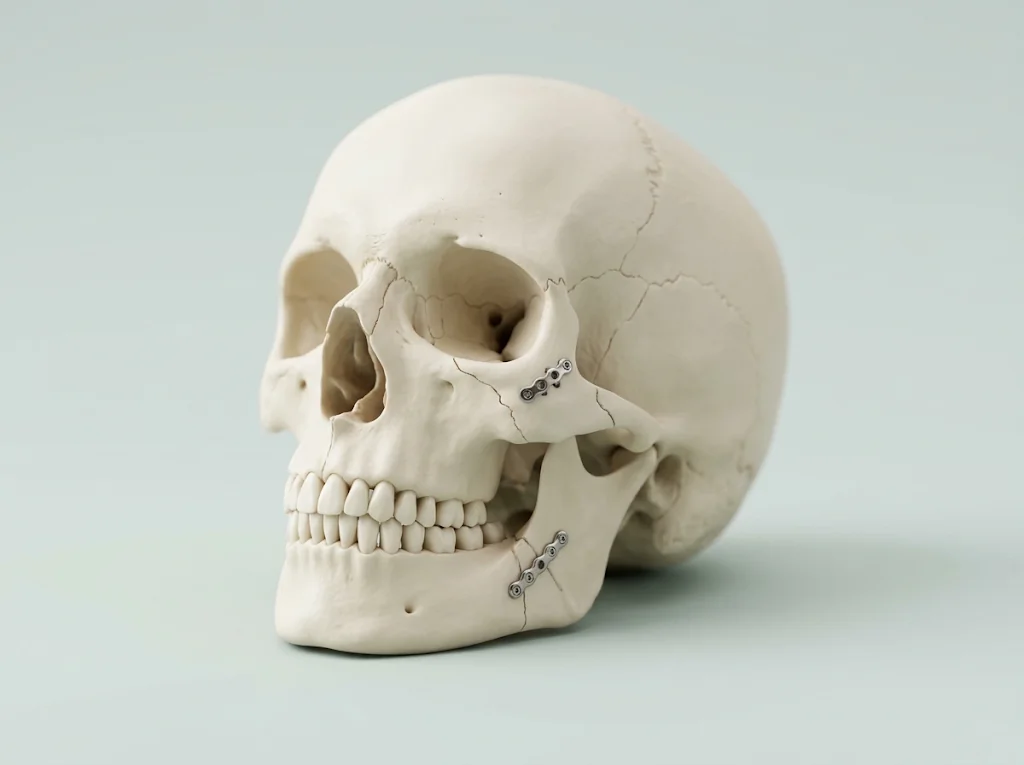
- Imaging
- CT or cone-beam CT
- Fixation
- Titanium plates and screws
- Approach
- From inside the mouth whenever possible
- No surgery
- Some fractures that didn't shift
When it's indicated
- Your teeth don't meet the way they used to: it is one of the most sensitive signs of a jaw fracture.
- Numbness of the lower lip and chin, or of the cheek and upper lip.
- Pain when opening or closing your mouth, or your jaw shifts to one side as it opens.
- Your cheekbone looks sunken, or you can feel a step along the rim of the eye socket.
- Loose teeth or a cut in the gum over the injury: the fracture may be open to the mouth.
- You were seen in an emergency room and the CT scan shows a fracture: what's left is deciding on surgery.
Before surgery
- Don't wait: a fracture through the teeth is open to the mouth, and a late visit may increase the risk of infection.
- Bring the CT scan (the files, not just the report) and your emergency room paperwork, if you were already seen.
- Until you are seen: soft or liquid food, don't force your mouth open, and cold packs.
- If you smoke, stop now: smoking has been linked to more complications, and it is a factor you can control.
- Tell me about your health conditions and medications, especially blood thinners, lung problems or mouth breathing.
How I plan it
How I do it
- 01DecisionWith the exam and the CT scan, I explain whether surgery makes sense and why. Cochrane reviewed 12 trials and found insufficient evidence to support any single approach for jaw fractures that don't involve the condyle: it is decided case by case.
- 02ReductionUnder general anesthesia and, whenever possible, from inside the mouth, I put each fragment back in place using your bite as the guide. Sometimes I hold the teeth together temporarily during surgery to confirm it.
- 03FixationTitanium plates and screws, following the principles of fracture fixation: anatomical reduction, stable fixation, preserving the bone's blood supply and allowing early movement.
- 04Follow-upCheck-ups of your bite, the incisions and sensation until the bone has healed. You can message me with any question during recovery.
Recovery
- The first few days bring the most swelling: cold packs, your head raised when you sleep, the prescribed medication and gentle brushing to keep the incisions clean.
- A soft diet for the weeks I tell you, depending on the fracture: chewing hard food too early loads the plates before the bone has healed.
- Antibiotics go before or during surgery; adding more afterwards did not reduce infections across 13 studies, so it isn't routine.
- After a cheekbone fracture it is common for the cheek or upper lip to feel numb: it happened to 51.9% in a review of 13 studies. I measure it at every check-up.
- Check-ups until the bone has healed, which takes weeks; contact sports only once I clear you.
Risks and how I prevent them
- Infection
- Any fracture through the teeth is open to the mouth. I prevent infection with antibiotics before or during surgery and clean incisions; if it happens, it is treated, and sometimes a plate has to come out.
- Bite or bone healing
- Jaw fractures carry a relatively high complication rate: a changed bite, poor bone healing or plate failure. I prevent this with the bite as the guide, stable fixation, a soft diet and check-ups; if the bite didn't end up right, I review it and plan how to correct it.
- Smoking
- Smoking was associated with more complications (odds ratios of 4.04 to 8.09 in three studies). At one center, among 135 people operated on for a jaw angle fracture, 17.2% of those operated on through the neck and 18.8% of those operated on from inside the mouth had a major complication; smoking mattered more than how it was operated on.
- Numbness
- The blow can injure the nerve to the lip and chin or the one to the cheek. I measure sensation before and after and protect the nerve during surgery; in the cheekbone, decompressing it within two weeks, when indicated, was associated with better recovery.
- Condyle surgery
- In fractures of the condylar neck, surgery with plates gave less joint pain and fewer bite problems than closed treatment (14 studies). On the other hand, infection was more frequent with surgery, though without statistical certainty, and there is a known risk to the facial nerve. We decide together.
- Eyes and vision
- Bleeding behind the eye is an emergency: of 93 cases, 22% became blind, and fast treatment was associated with full recovery. At any change in vision, go to the emergency room.
Other options
- No surgery
- A fracture that didn't shift or change your bite can be managed with a soft diet and follow-up imaging. If it moves, the plan is revisited.
- Closed treatment
- The teeth are held together with wires or elastics while the bone heals, without opening; it works for stable fractures and some condylar fractures. It reduces breathing function while in place and is not recommended with lung disease or if you breathe through your mouth.
Frequently asked questions
I hit my face: what should I do in the first few hours?
With warning signs (breathing, bleeding, a blow to the head, vision, neck), go to the emergency room. If not: cold packs, soft food, don't force your mouth, and get seen soon, especially with a cut in the gum or loose teeth.
How do I know if my jaw is broken?
The most sensitive signs are teeth that no longer meet the way they used to and numbness of the lower lip or chin. It is confirmed with a CT scan.
Will my jaw be wired shut?
Not necessarily. With stable plates, the idea is to move your jaw early. Sometimes elastics are used afterwards; prolonged wiring is reserved for specific cases.
Do the plates and screws stay in?
Usually yes: they are titanium. They are removed if a plate becomes infected, loosens or bothers you.
How long is recovery?
The bone heals over weeks. The soft diet and going back to work depend on the fracture and how it was fixed; I give you dates at the consultation and adjust them at every check-up.
A tooth broke or came loose in the accident: what should I do?
It may be the tooth alone, but if several moved together as a block or your bite changed, the bone may be fractured. If a tooth was knocked out completely, get dental care right away and keep it in milk or your saliva, without touching the root.
How much does it cost? And what if it was a traffic or work accident?
The consultation is 60,000 colones and a video consultation is 20,000 colones, useful for reviewing a CT scan; the fracture is confirmed in person. I give you the cost of surgery after reviewing the CT scan. If it was an accident, ask your insurer first what they cover.
Sources
- 1.Ellis E III, Schubert W (ed. Buchbinder D) — Examination of patients with mandibular fractures. AO Surgery Reference, CMF Trauma — Mandible. AO Foundation, n.d.
- 2.Ellis E III, Schubert W (ed. Buchbinder D) — Complications — Mandibular fractures. AO Surgery Reference, CMF Trauma — Mandible. AO Foundation, n.d.
- 3.Othman A et al. — Traumatic brain injuries and maxillofacial fractures: a systematic review and meta-analysis. Oral Maxillofac Surg, 2023.
- 4.Jazayeri HE et al. — Fixation Points in the Treatment of Traumatic Zygomaticomaxillary Complex Fractures: A Systematic Review and Meta-Analysis. J Oral Maxillofac Surg, 2019.
- 5.Ahmed A et al. — Potentially modifiable patient factors in mandible fracture complications: a systematic review and meta-analysis. Br J Oral Maxillofac Surg, 2022.
- 6.Chen CL et al. — Complications and Reoperations in Mandibular Angle Fractures. JAMA Facial Plast Surg, 2018.
- 7.Nasser M et al. — Interventions for the management of mandibular fractures. Cochrane Database Syst Rev, 2013.
- 8.Beeharry MW, Ahmad B — Principles of Fracture Healing and Fixation: A Literature Review. Cureus, 2024.
- 9.Habib AM et al. — Postoperative prophylactic antibiotics for facial fractures: A systematic review and meta-analysis. Laryngoscope, 2019.
- 10.Mehta UB et al. — Evaluating infra-orbital nerve injury in zygomaticomaxillary complex fractures: a systematic review and meta-analysis. Front Oral Health, 2025.
- 11.Jazayeri HE et al. — Comparative Benefits of Open versus Closed Reduction of Condylar Fractures: A Systematic Review and Meta-Analysis. Plast Reconstr Surg, 2023.
- 12.Christie B et al. — Retrobulbar hematoma: A systematic review of factors related to outcomes. J Plast Reconstr Aesthet Surg, 2018.
- 13.de Carvalho Sampaio TR et al. — Does Maxillomandibular Fixation Affect Respiratory Function? A Systematic Review. J Craniofac Surg, 2022.
Reviews from my patients (not necessarily about this procedure)
«Desde que entramos al área de parqueo se siente la seguridad y confianza, la recepcionista muy amable y simpática, poco antes de la hora de la cita nos avisan que había un pequeño atraso por una complicación con el paciente que tenía el Dr. Torres en ese momento la espera no fue larga y de todos modos el área de espera es muy amplia y agradable, El Dr. Torres muy amable y profesional en todo momento, no escatimó tiempo para dar una amplia explicación del procedimiento, en general mi esposa y yo nos sentimos muy cómodos y sobretodo con mucha confianza de estar en las manos adecuadas.Definitivamente 100% recomendados !»«El Doctor Ronald Torres es un excelente profesional. Lo recomiendo 100%. Su trato siempre ha sido amable, cortes, profesional. Se interesa en comprender la necesidad del paciente, y en todo momento trata que este comprenda bien los alcances del procedimiento a realizar. Ya me ha extraido dos cordales, y puedo decir que me fue muy bien. Puede tener confianza de buscar al Dr. Ronald, que le aseguro quedara satisfecho con su atencion.»«Excelente profesional, impecable en la técnica de su especialidad y con un trato humano digno de resaltar. Desde el día uno nos sentimos cómodos con él y esto se mantuvo y se ha mantenido hasta el día de hoy, en donde estamos ya con citas de mero seguimiento. La intervención quirúrgica realizada fue un éxito y el costo muy razonable. La verdad que gracias a Dios tomamos una excelente decisión con él. Súper recomendado.»«Mi hijo Luis Guillermo se realizó una cirugía maxilofacial con el doctor Torres y su equipo, el resultado fue y es a hoy excelente, recibió un servicio excelente de seguimiento después de su cirugía.Le cambió mucho la vida a mi hijo de forma positiva , una gran inyección de seguridad y autoestima.Como padres nos sentimos muy agradecidos y es de esas inversiones que valen la pena .»
Other procedures
- 01Wisdom teeth surgery
- 02Dental implants
- 03All-on-4 immediate full arch
- 04Orthognathic surgery
- 05Sinus lift
- 06TMJ treatment and surgery
- 08Jaw cysts and tumors
- 09Buccal fat removal
- 10Extractions and abscesses
- 11Bone grafting and socket preservation
- 12Oral lesions and biopsy
- 13Zygomatic implants
- 14Video consultation and second opinion