 Dr. Ronald Torres Labardini ·
The short answer
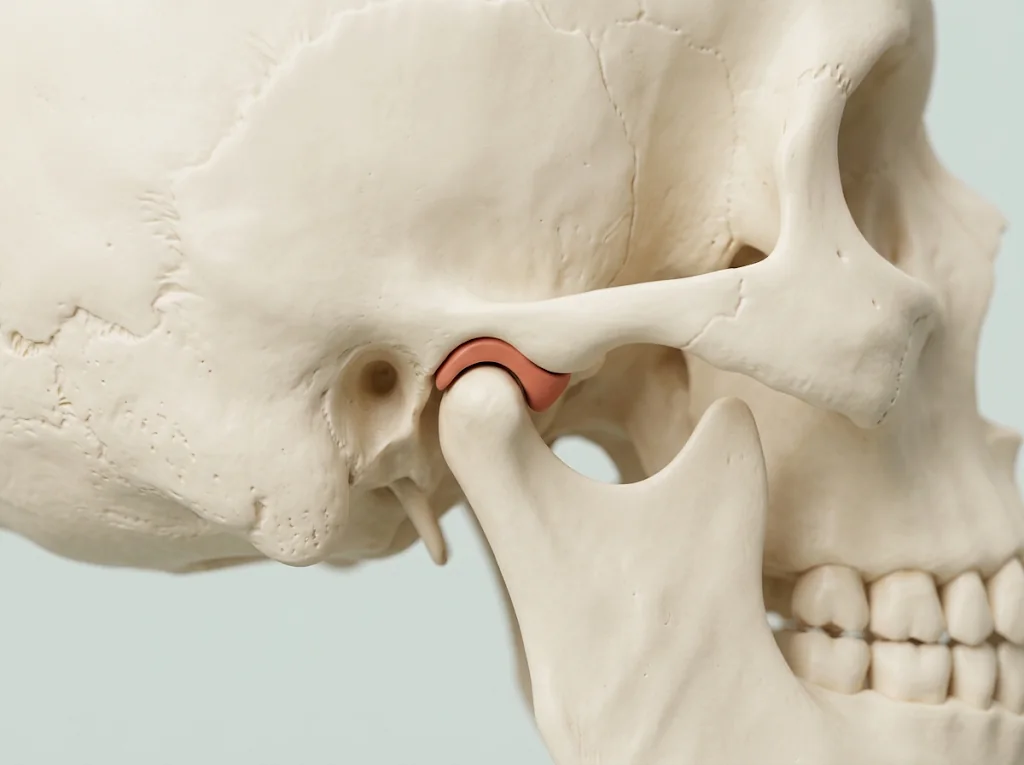
When the pain comes from the muscles that move the jaw or from the temporomandibular joint (TMJ), we call it a temporomandibular disorder (TMD): the second most common chronic musculoskeletal pain condition after low back pain, affecting 6–9% of adults. Most people with TMD who don't have severe psychosocial impairment tend to improve, even without active treatment.
TMJ or not? The most common causes
- Chewing muscles: a dull ache in the cheek or temple, worse with chewing or by the end of the day. Stress tends to make it worse.
- Bruxism (clenching or grinding your teeth), by day or at night: stiffness on waking, worn teeth, pain at the temples. Many people clench without noticing.
- The joint: pain in front of the ear, clicking, a jaw that catches and won't open all the way or that slips out and is hard to close. Clicking that doesn't hurt, with good opening, often needs no treatment: about 70 in 100 conditions inside the joint remain stable over time.
- Teeth and gums: a molar with deep decay or an abscess, or a wisdom tooth with inflamed gum. The pain throbs and gets worse with cold, heat or biting. What fixes it is treating the tooth: the first treatment for an abscess is removing the source of infection with a local procedure, and antibiotics are reserved for infection that's spreading or causing fever or malaise.
- Ear and sinuses: the TMJ sits right in front of the ear, so its pain is often felt as an earache. It works the other way too: an ear infection or sinusitis can be felt in the jaw or the upper back teeth. With fever, discharge or hearing loss, see your doctor first.
- Less common: facial nerve pain (neuralgia), a fracture, or your heart.
When to go to the ER and when to message me
- Jaw pain with chest pain or pressure, shortness of breath, a cold sweat or nausea: call 911 right away. It may be your heart, not your TMJ.
- Swelling of the face or under the jaw with fever, spreading toward the eye or neck, or making it hard to swallow, breathe or open your mouth: go to the ER without waiting for my reply. Among people seen in US emergency departments for a dental-origin infection, 9.8% had a severe complication.
- After a blow, teeth that no longer meet as before or a numb lower lip and chin: these are sensitive signs of a fracture. Go to the ER, or message me that same day.
- Your jaw is stuck open and won't close: contact the office or go to the ER.
- An older person with new jaw pain when chewing that eases with rest, plus a headache at the temple or vision changes: see a doctor that same day.
- Message me if you don't improve in a few weeks with home measures, if your jaw has locked, if the clicking has started to hurt, if your bite has changed without a blow, or if you notice an unexplained lump or numb area.
Conservative care comes first
Every TMD starts with reversible care. For pain lasting 3 months or more, the international guideline published in the BMJ in 2023 strongly recommends cognitive behavioral therapy, mobilization by a physical therapist, manual trigger-point therapy, supervised postural and jaw exercises, and usual care (home exercises, stretching, reassurance and education). In an analysis of 153 trials, compared with placebo, about 36 more people in 100 achieved a pain improvement they could notice with cognitive behavioral therapy plus biofeedback or relaxation, 36 more in 100 with mobilization by a physical therapist, and 32 more in 100 with manual trigger-point therapy.
- Soft foods during flares; no gum, ice or nail biting.
- Moist heat or cold on the muscle.
- During the day: lips together, teeth apart, tongue relaxed.
- Sleep well and lower stress.
- Guided exercises: in 16 studies (812 participants), exercise reduced pain and improved opening, and added to a splint it worked better than a splint alone.
- If you need a pain reliever, ask which one suits you; the BMJ guideline strongly recommends against combining anti-inflammatories with opioids.
What about a splint or night guard?
It can be part of a plan, but its effect on pain is uncertain. The 2024 Cochrane review (57 studies, 2,846 participants) found there isn't enough evidence to know whether splints work; a hard stabilization splint may reduce muscle pain when chewing compared with no treatment, with a lot of uncertainty. For chronic pain as a group, the BMJ guideline makes a conditional recommendation against reversible splints and a strong one against irreversible ones. If a splint is part of your plan, it should be reversible and paired with exercise. Grinding down teeth or changing your bite to treat the TMJ is not recommended.
The plan, step by step
- Step 1Diagnosis: your history and an exam of the muscles, joint, teeth and bite; imaging when it's indicated.
- Step 2Self-care and education: habits, sleep and stress.
- Step 3Physical therapy, exercise and pain management; a reversible splint if it helps.
- Step 4Arthrocentesis, if there's a locked jaw with pain or limited opening that doesn't improve.
- Step 5Joint surgery, in a minority of cases.
Arthrocentesis and surgery: when they're considered
TMJ surgery is reserved for a minority of cases, and most of those can be managed with minimally invasive techniques such as arthrocentesis: washing out the joint through fine needles, as an outpatient procedure under local anesthesia. It isn't a first step: as a first treatment it may give a small improvement in pain, with no extra gain in opening over conservative care, and for chronic pain as a group the BMJ guideline makes a conditional recommendation against it.
- Where it makes the most sense is a locked jaw: the joint's disc has slipped, doesn't go back into place, and your mouth won't open fully. In 16 trials with 742 patients with a painful locked jaw, arthrocentesis reduced pain more in the intermediate term than conservative care (low-quality evidence); conservative care improved opening more in the short term.
- Compared with a splint, the reviews disagree: in one (6 studies, 343 participants) arthrocentesis improved opening more, with no clear difference in pain; in another, splints controlled joint pain better, though from very different studies.
- Doing it within the first 3 months of conservative care might give good results, although the ideal timing is unclear; according to one review, three to five sessions work better than one.
- Surgery is considered when that isn't enough or there's a structural problem, such as a fused joint (ankylosis) or a tumor. In 13 studies, arthroscopy didn't reduce pain more than arthrocentesis, and open joint surgery should not be the first treatment.
What the consultation looks like
I examine you and explain what I found before suggesting anything. One patient wrote on HuliHealth (in Spanish): «me explicó de forma clara las particularidades del trastorno temporomandibular, así como posibles tratamientos» ("he clearly explained the particulars of temporomandibular disorder, as well as possible treatments"; Aldo R., April 28, 2021). It's one of my 104 reviews there, which average 5.0.
- Consultation: 60,000 colones at my office in Tower 1 of Hospital CIMA, in Escazú; video consultation: 20,000.
- If you live far away, we can start by video: in a small study (16 people), a video exam agreed well with the reference exam for muscle and joint pain, but poorly for disc displacement with reduction. If needed, I examine you in person.
- I'm an oral and maxillofacial surgeon (specialty at UNAM, Mexico, 2013), certified by the Mexican Board of Oral and Maxillofacial Surgery, and a professor at the University of Costa Rica School of Dentistry since 2006.
Sources
- 1.Busse JW et al. — Management of chronic pain associated with temporomandibular disorders: a clinical practice guideline. BMJ, 2023.
- 2.AADOCR — Temporomandibular Disorders (TMDs) Position Statement. American Association for Dental, Oral, and Craniofacial Research, 2026.
- 3.Cope AL et al. — Systemic antibiotics for symptomatic apical periodontitis and acute apical abscess in adults. Cochrane Database Syst Rev, 2024.
- 4.Wu BW et al. — Prevalence and Risk Factors for Severe Complications of Odontogenic Infections. J Oral Maxillofac Surg, 2026.
- 5.Ellis E III, Schubert W (ed. Buchbinder D) — Examination of patients with mandibular fractures. AO Surgery Reference, CMF Trauma — Mandible. AO Foundation, n.d.
- 6.Yao L et al. — Management of chronic pain secondary to temporomandibular disorders: a systematic review and network meta-analysis of randomised trials. BMJ, 2023.
- 7.Idáñez-Robles AM et al. — Exercise therapy improves pain and mouth opening in temporomandibular disorders: A systematic review with meta-analysis. Clin Rehabil, 2023.
- 8.Singh BP et al. — Occlusal interventions for managing temporomandibular disorders. Cochrane Database Syst Rev, 2024.
- 9.Hu Y et al. — Arthrocentesis vs conservative therapy for the management of TMJ disorders: A systematic review and meta-analysis. J Stomatol Oral Maxillofac Surg, 2023.
- 10.Al-Moraissi EA et al. — Treatment of painful temporomandibular joint disc displacement without reduction: network meta-analysis of randomized clinical trials. Int J Oral Maxillofac Surg, 2024.
- 11.Dawoud BE et al. — Arthrocentesis versus occlusal coverage splints in the management of disc displacement without reduction: a systematic review and meta-analysis. Int J Oral Maxillofac Surg, 2024.
- 12.Guarda-Nardini L et al. — Arthrocentesis of the Temporomandibular Joint: Systematic Review and Clinical Implications of Research Findings. J Oral Facial Pain Headache, 2021.
- 13.Li DTS et al. — Timing of arthrocentesis in the management of temporomandibular disorders: an integrative review and meta-analysis. Int J Oral Maxillofac Surg, 2021.
- 14.Tang YH et al. — Arthroscopy versus arthrocentesis and versus conservative treatments for temporomandibular joint disorders: a systematic review with meta-analysis and trial sequential analysis. Int J Oral Maxillofac Surg, 2024.
- 15.Rodhen RM et al. — Invasive surgical procedures for the management of internal derangement of the temporomandibular joint: a systematic review and meta-analysis regarding the effects on pain and jaw mobility. Clin Oral Investig, 2022.
- 16.Exposto FG et al. — Remote physical examination for temporomandibular disorders. Pain, 2022.