01 · Oral & maxillofacial surgery
Wisdom teeth removal in Costa Rica
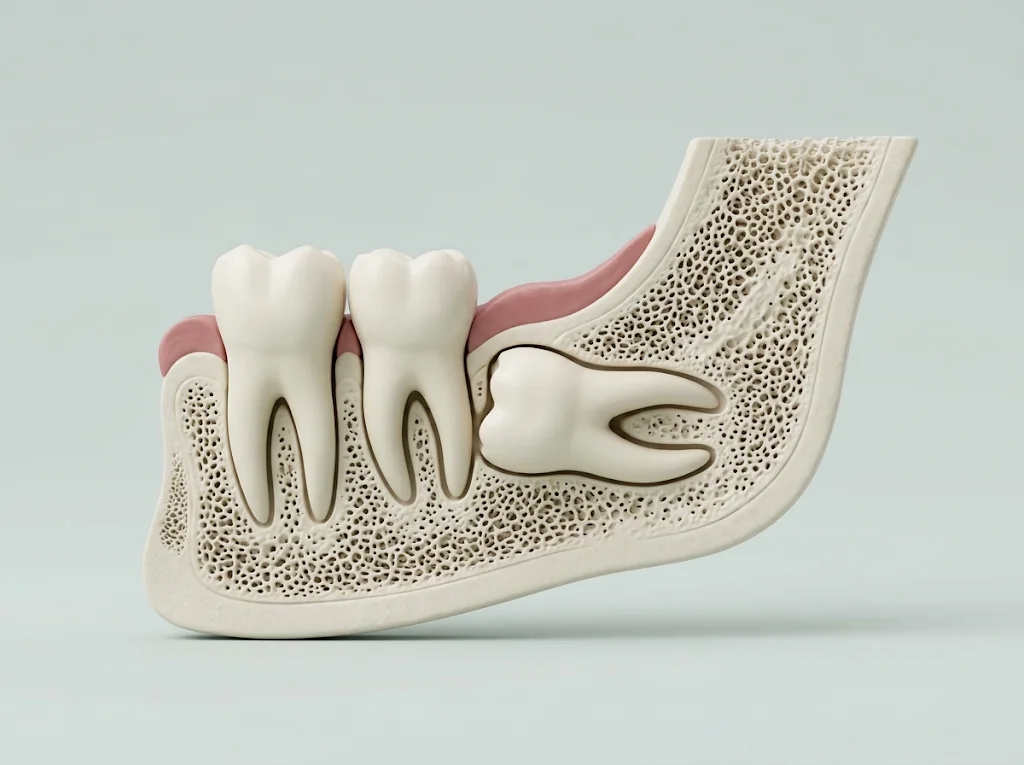
Many wisdom teeth have no room: they stay trapped in the bone or partly through the gum, where they can get infected or damage the neighboring molar. Others are healthy and can stay, with regular check-ups. Before deciding, I measure where each one sits, how it is tilted and how close the nerve runs. I am an oral and maxillofacial surgeon (UNAM), certified by the Mexican Board of Oral and Maxillofacial Surgery, and I see patients in Tower 1 of Hospital CIMA.
Swelling spreading toward your eye, neck or under your tongue, fever, trouble swallowing or breathing, or opening your mouth getting harder each day: go to the emergency room immediately. Severe pain starting between day 1 and day 5 after surgery: message me or call the office.
- Imaging
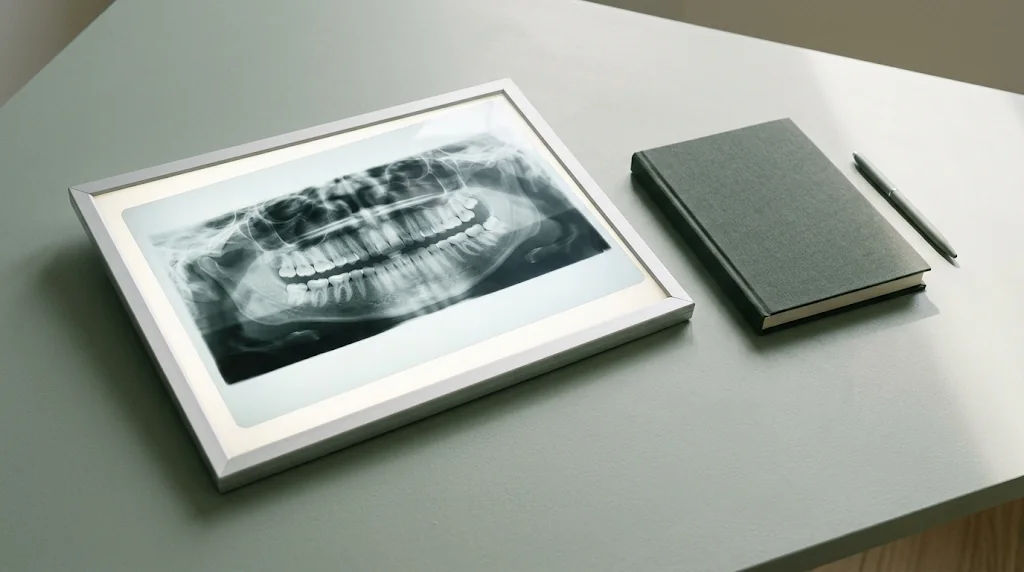
- Panoramic X-ray; CT if a root is near the nerve
- Anesthesia
- Local; sedation depending on the case
- Hardest day
- Usually the first
- Consultation
- 60,000 colones · by video, 20,000
When it's indicated
- Pericoronitis (infected gum over the tooth) that comes back; a first, mild episode is usually not enough.
- Decay that can no longer be fixed, or a nerve or root infection that cannot be treated.
- An abscess, cellulitis or osteomyelitis (bone infection).
- Resorption of the wisdom tooth or the neighboring molar, or a fractured tooth.
- A cyst or tumor around the wisdom tooth.
- It is in the way of jaw surgery, such as orthognathic surgery, or of a tumor treatment.
Before surgery
- If you already have a panoramic X-ray or CT scan, bring it or send it ahead; we can review it first by video.
- Bring a list of your medications. If you take blood thinners, don't stop them on your own: stopping is associated with a higher risk of blood clots. I coordinate with your doctor.
- Tell me if you take bisphosphonates (osteoporosis drugs) or have a weakened immune system: in those cases the plan is coordinated with your doctor.
- If you smoke, stop before surgery and while you heal: dry socket is more common in smokers.
- If we use sedation, follow my written fasting instructions and come with someone: you can't drive that day.
How I plan it
How I do it
- 01ConsultationI review your imaging, health and medications, and explain which teeth to remove, which to monitor, and why.
- 02AnesthesiaLocal and, if we agree on it, sedation. You feel pressure and movement; if you feel pain, tell me and I add more anesthetic.
- 03Removal and closingI open the gum and, when needed, remove bone and divide the tooth to take it out in pieces; then I clean and close with stitches. The technique depends on the tooth's position and how close the nerves are.
- 04Instructions and follow-upYou leave with written instructions and a follow-up appointment. Antibiotics are not routine: I decide based on your health and your risk. While you recover, you can message me.
Recovery
- The first day is usually the hardest; after that it generally keeps improving.
- Pain, swelling and difficulty opening your mouth are expected and temporary; in one study, about 94% had mild to moderate swelling.
- Cold packs outside for the first few hours, soft food, gentle hygiene, and the prescribed medication on schedule.
- To protect the clot: no smoking, no forceful spitting, no straws and no vigorous rinsing.
- If your lip or tongue stays numb, let me know: in a large study, by the end of follow-up 67% of lip cases and 72% of tongue cases had fully recovered; follow-up can take months.
Risks and how I prevent them
- Lip and chin numbness
- It involves the inferior alveolar nerve, with lower wisdom teeth. In a review of 44,171 impacted lower wisdom tooth extractions it was temporary in 1.20 out of 100 and did not recover in 0.28 out of 100; depending on the study, nerve injury is reported between 0.35% and 8.4%. That is why I measure first and, if the root is pressed against the nerve, suggest a coronectomy or monitoring.
- Tongue numbness
- It involves the lingual nerve. In a study of 4,338 extractions it occurred in 0.69%; injury that does not recover ranges from 0.07% to 0.28% by technique, so I choose the technique for your case.
- Dry socket
- The clot is lost: severe pain that usually starts between day 1 and day 5, sometimes with bad breath. It happens in about 6.7 out of 100 impacted lower wisdom tooth extractions. Smoking makes it more common: in a review of extractions in general, 13.2% in smokers vs. 3.8% in non-smokers. If it happens, message me so I can check it.
- Infection
- Preventive antibiotics may reduce it, but 18 to 19 people must take them to prevent one infection, so I decide based on your risk. Keeping and removing the tooth both carry risks: the most reported causes of wisdom-tooth hospital admissions include pericoronitis and infections after removal.
- Bleeding
- With newer oral blood thinners, bleeding after mouth procedures was similar whether people continued them (11.8%) or stopped them (13.5%), and in those studies all of it was controlled with local measures.
- If a coronectomy is done
- The roots left behind often shift (13% to 85% depending on the study) and, depending on the review, 2.2% to 3.63% needed another surgery. It is followed with X-rays.
Other options
- Not operating, and monitoring
- For an impacted tooth that is healthy and trouble-free, a Cochrane review finds not enough evidence to choose between removing or keeping it, and the UK's NICE guidance recommends against preventive removal: we check it at regular visits. Very low-certainty evidence suggests keeping it may be associated, in the long term, with more gum problems on the neighboring molar.
- Coronectomy
- If the root is pressed against the nerve, I remove only the crown. In observational studies it can reduce nerve injury and dry socket compared with full removal.
- First episode without surgery
- A first, mild episode of pericoronitis is treated locally. If it comes back, we talk about it.
Frequently asked questions
How much does wisdom teeth removal cost?
It depends on how many teeth, how deep they are, whether a CT scan is needed and whether we use sedation, so I don't publish surgery prices. A consultation is 60,000 colones at the office and 20,000 by video; with your imaging in front of me, I give you the cost for your case.
Does it hurt? Is it local anesthesia or sedation?
With local anesthesia the area is numb: you can expect to feel pressure and movement, not pain; if something hurts, tell me and I add more anesthetic. If you're very anxious or the surgery is longer, we consider sedation. Afterwards there is discomfort, mostly on the first day, which we manage with medication.
How many days off work will I need?
It depends on how many teeth, their position and your work: I tell you at the consultation. What holds is that the first day is usually the hardest.
Can all four wisdom teeth come out at once?
Yes, in many cases, in a single surgery; it depends on the position of each tooth and your health. We decide at the consultation.
Do I always need a CT scan?
No. A panoramic X-ray is often enough; I order a CT scan if it shows a root near the nerve. If you have one, bring it.
Do wisdom teeth have to come out if they don't hurt?
Not always. For healthy teeth, the evidence doesn't show removal is preferable to keeping them: we monitor them. They come out for a specific problem, such as recurring infection, unfixable decay, damage to the neighboring molar, or a cyst.
Sources
- 1.Ghaeminia H et al. — Surgical removal versus retention for the management of asymptomatic disease-free impacted wisdom teeth. Cochrane Database Syst Rev, 2020.
- 2.NICE — Guidance on the extraction of wisdom teeth (technology appraisal guidance TA1). National Institute for Health and Care Excellence, UK, 2000.
- 3.Su N et al. — Predictive Value of Panoramic Radiography for Injury of Inferior Alveolar Nerve After Mandibular Third Molar Surgery. J Oral Maxillofac Surg, 2017.
- 4.Clé-Ovejero A et al. — Does 3-dimensional imaging of the third molar reduce the risk of experiencing inferior alveolar nerve injury owing to extraction?: A meta-analysis. J Am Dent Assoc, 2017.
- 5.Ghaeminia H et al. — Clinical relevance of cone beam computed tomography in mandibular third molar removal: A multicentre, randomised, controlled trial. J Craniomaxillofac Surg, 2015.
- 6.Kang F et al. — Determining the risk relationship associated with inferior alveolar nerve injury following removal of mandibular third molar teeth: A systematic review. J Stomatol Oral Maxillofac Surg, 2020.
- 7.Sarikov R, Juodzbalys G — Inferior alveolar nerve injury after mandibular third molar extraction: a literature review. J Oral Maxillofac Res, 2014.
- 8.Cheung LK et al. — Incidence of neurosensory deficits and recovery after lower third molar surgery: a prospective clinical study of 4338 cases. Int J Oral Maxillofac Surg, 2010.
- 9.Lee J et al. — Incidence of lingual nerve damage following surgical extraction of mandibular third molars with lingual flap retraction: A systematic review and meta-analysis. PLoS One, 2023.
- 10.Kostares E et al. — Prevalence of fibrinolytic alveolitis following extraction of impacted mandibular third molars: A systematic review and meta-analysis. J Stomatol Oral Maxillofac Surg, 2024.
- 11.Kuśnierek W et al. — Smoking as a Risk Factor for Dry Socket: A Systematic Review. Dent J (Basel), 2022.
- 12.Lodi G et al. — Antibiotics to prevent complications following tooth extractions. Cochrane Database Syst Rev, 2021.
- 13.Camps-Font O et al. — Antibiotic prophylaxis in the prevention of dry socket and surgical site infection after lower third molar extraction: a network meta-analysis. Int J Oral Maxillofac Surg, 2024.
- 14.Lau T et al. — Potentially Preventable Hospitalisation Related to Severe Third Molar Disease: A Systematic Review. Dent J (Basel), 2026.
- 15.Manfredi M et al. — World workshop on oral medicine VII: Direct anticoagulant agents management for invasive oral procedures: A systematic review and meta-analysis. Oral Dis, 2019.
- 16.Engelen ET et al. — Antifibrinolytic therapy for preventing oral bleeding in people on anticoagulants undergoing minor oral surgery or dental extractions. Cochrane Database Syst Rev, 2018.
- 17.Kang FW et al. — Coronectomy in Lower Third Molar Surgery: A Systematic Review and Meta-Analysis. J Oral Maxillofac Surg, 2025.
- 18.Pitros P et al. — A systematic review of the complications of high-risk third molar removal and coronectomy: development of a decision tree model and preliminary health economic analysis to assist in treatment planning. Br J Oral Maxillofac Surg, 2020.
- 19.Duarte-Rodrigues L et al. — Third molar removal and its impact on quality of life: systematic review and meta-analysis. Qual Life Res, 2018.
- 20.Chaudhary G et al. — Does the clinical complexity of impacted mandibular third molars influence postoperative recovery? BMC Oral Health, 2026.
Reviews that mention this procedure
«El resultado de la extracción de muela fue EXCELENTE»«Excelente especialista, super recomendado, mi hijo tuvo la extracción de sus cordales y le fue super bien»«Tuve una cirugia de 3 cordales al mismo tiempo, me ayudo para que estuviese lo mas relajada, me dio medicamento adicional para asegurar sentir lo menos posible, no fue nada traumatico el proceso, y el Dr es muy atento»«El Doctor Ronald Torres es un excelente profesional. Lo recomiendo 100%. Su trato siempre ha sido amable, cortes, profesional. Se interesa en comprender la necesidad del paciente, y en todo momento trata que este comprenda bien los alcances del procedimiento a realizar. Ya me ha extraido dos cordales, y puedo decir que me fue muy bien. Puede tener confianza de buscar al Dr. Ronald, que le aseguro quedara satisfecho con su atencion.»GuidesWhen should wisdom teeth come out (and when can they stay)? GuidesAfter wisdom teeth removal: a day-by-day guide
 GuidesYour first visit with an oral and maxillofacial surgeon
Other procedures
- 02Dental implants
- 03All-on-4 immediate full arch
- 04Orthognathic surgery
- 05Sinus lift
- 06TMJ treatment and surgery
- 07Facial trauma
- 08Jaw cysts and tumors
- 09Buccal fat removal
- 10Extractions and abscesses
- 11Bone grafting and socket preservation
- 12Oral lesions and biopsy
- 13Zygomatic implants
- 14Video consultation and second opinion