04 · Oral & maxillofacial surgery
Orthognathic jaw surgery in Costa Rica: the plan comes first
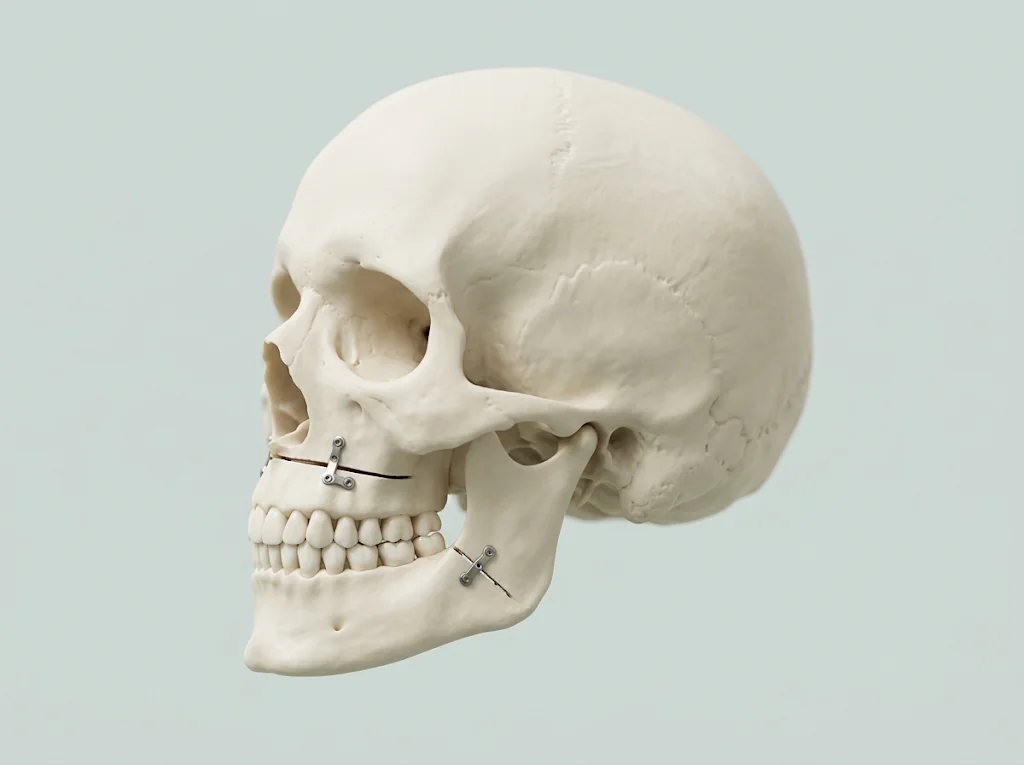
When the bite doesn't close because the bones — not the teeth — are out of place, braces alone can't fix it. Orthognathic surgery moves the upper jaw, the lower jaw or both into a position measured beforehand, together with your orthodontist. Before operating I measure every movement in millimeters, check the airway and the jaw joints, and explain what you can and can't expect.
If you've already had surgery and you're short of breath, bleeding that won't stop, or the swelling increases with a fever after the first few days, call the office right away or go to the emergency room.
- Anesthesia
- General, in hospital
- Planning
- Cephalometry, CT scan and models
- Teamwork
- With your orthodontist, before and after
- Hospital stay
- Set in your plan, case by case
When it's indicated
- A lower jaw that sits too far forward (underbite) or too far back, when the difference is in the bone and braces can't compensate.
- Open bite: the front teeth don't touch when you close.
- Facial asymmetry caused by the bones, or a chin that sits off-center.
- Trouble chewing, closing the lips or speaking because of the size or position of the jaws.
Before surgery
- Pre-surgical orthodontics: the bite can look worse, and studies indicate quality of life tends to dip before it improves (the evidence is limited). That's expected.
- Wisdom teeth and smoking: they are among the most-cited risk factors in lower-jaw surgery. We decide early whether the wisdom teeth should come out, and I'll ask you to quit smoking.
- Healthy gums and any cavities treated.
- Blood tests and an anesthesia evaluation. If you snore or stop breathing in your sleep, tell me: you may need a sleep study.
How I plan it
How I do it
- 01ConsultationI look at your bite, your face and your imaging, and we talk about what bothers you. If surgery isn't what you need, I'll tell you.
- 02Pre-surgical orthodonticsYour orthodontist prepares the teeth over several months; together we decide when to operate.
- 03PlanningWith recent imaging I set how many millimeters each bone moves and in which direction, and the splints are made.
- 04SurgeryIn hospital, under general anesthesia and from inside the mouth. I cut the bone in a controlled way (osteotomies), bring it to the planned position with the splint and fix it with titanium plates and screws. I use medication to help prevent nausea and reduce swelling.
- 05Check-ups and final orthodonticsFrequent check-ups at first; then your orthodontist fine-tunes the bite.
Recovery
- Swelling peaks between 48 and 72 hours, then goes down.
- For the first two weeks the mouth doesn't open much: a liquid, then soft, diet.
- Lip and chin numbness is the most bothersome and longest-lasting symptom; for most people it improves over the months.
- At 5 weeks, in 378 patients after two-jaw surgery, the most common complaint was nasal congestion (55.6%).
- Mouth opening keeps improving steadily over three months.
- Going back to school or the office is gradual and depends on the case; there's no number I can promise you.
Risks and how I prevent them
- Lip and chin numbness
- The most common effect of lower-jaw surgery. Across 47 studies, 1 in 5 people (21%) still had some altered sensation at one year; change that doesn't resolve is reported from 3.4%, because each study measures it differently. In the 47-study review, risk was higher with large advancements and nerve manipulation, so I locate the nerve on the CT and plan the cut away from it. The tongue is rarely affected (0.1% to 0.7%).
- Infection and plate removal
- Infection: from 3.55% in two-jaw surgery to 9.6% in lower-jaw series. Removal of a plate: from 4.21% to 11.2%. To lower the risk: antibiotics per protocol, good hygiene and not smoking (smoking and age are among the most-cited risk factors); a plate that bothers you can be removed later.
- Unplanned fracture
- When the lower jaw is split, the bone can break where it wasn't planned (2.3% of operated sides). It's generally handled during the same surgery.
- Relapse
- The bone can partly drift back. In retruded lower jaws followed for 5 to 13 years there was some relapse, generally within clinically acceptable limits. Orthodontics, stable fixation and follow-up help hold the result.
- Airway and sleep
- In one review, 12.25% of people who had two-jaw surgery for a deformity developed sleep apnea afterwards: a signal to assess sleep before and after, not an individual risk.
- Sinusitis and facial nerve
- After upper-jaw surgery, sinusitis occurred in 3.3% of cases; I watch for it at check-ups. Facial-nerve weakness is rare (0.04% to 0.77%), and 79.6% of reported cases recovered completely with conservative care.
Other options
- Orthodontic camouflage
- In mild cases, braces compensate by tilting the teeth. It improves the bite but doesn't change jaw position or your profile.
- Surgery first
- In selected cases surgery comes before orthodontics. In a review of 12 studies it was somewhat less stable than the traditional order.
- Not operating
- A valid choice if the problem is mild, there's no functional issue, or you'd rather not take on the risks. The decision is yours.
- If the reason is sleep apnea
- In randomized trials CPAP outperformed the other options, and the guideline suggests trying it first; a mandibular advancement device is another option if you can't tolerate it.
Frequently asked questions
Who is a candidate for orthognathic surgery?
Someone with a difference between the jaws that affects the bite, chewing, lip closure or breathing, and that orthodontics alone can't correct. Facial growth generally has to be complete and your health has to allow general anesthesia. Braces come before and after, coordinated with your orthodontist.
How much does jaw surgery cost in Costa Rica?
It depends on whether one or both jaws move, the hospital, the length of stay and the imaging; I give you an estimate after the consultation. A consultation is 60,000 colones and a video consultation 20,000 colones.
Can it be done through the CCSS (Costa Rica's public health system)?
The CCSS has a network care protocol for orthognathic surgery, with its own criteria and timelines. In my private practice you can get an evaluation or a second opinion: bring your imaging.
How long is the surgery and how many days in hospital?
It depends on whether one or both jaws are operated on. In a review of 18 studies (1,734 patients), two-jaw surgery took an average of 326.95 minutes, with an average stay of 3.25 days. I confirm your case in the plan.
Will there be scars on my face?
In the vast majority of cases, no: the surgery is done from inside the mouth.
Will my jaws be wired shut?
With titanium plates, prolonged rigid wiring is usually not needed; guiding elastics are used as needed.
Can orthognathic surgery treat sleep apnea?
In selected adults who can't tolerate CPAP, advancing both jaws is one of the surgeries considered. In reviews of operated sleep apnea patients, it achieved "surgical success" (lowering the apnea index by more than 50% to under 20 events per hour) in 79.6% to 85.5%, and "cure" (under 5 per hour) in 38.5% to 39%. If you have sleep apnea, bring your sleep study and I'll explain whether your jaws play a role.
Sources
- 1.Alkhayer A et al. — Accuracy of virtual planning in orthognathic surgery: a systematic review. Head Face Med, 2020.
- 2.Al-Moraissi EA et al. — Do patients with malocclusion have a higher prevalence of temporomandibular disorders than controls both before and after orthognathic surgery? A systematic review and meta-analysis. J Craniomaxillofac Surg, 2017.
- 3.Grinberg N et al. — Posterior airway compromise following orthognathic surgery in skeletal class III patient - A systematic review and meta-analysis. Sleep Med, 2025.
- 4.AADOCR — Temporomandibular Disorders (TMDs) Position Statement. Science Policy (iadr.org), 2026.
- 5.Brouns VEHW et al. — Oral health-related quality of life before, during, and after orthodontic-orthognathic treatment: a systematic review and meta-analysis. Clin Oral Investig, 2022.
- 6.Jean S et al. — Perioperative Systemic Corticosteroids in Orthognathic Surgery: A Systematic Review and Meta-Analysis. J Oral Maxillofac Surg, 2017.
- 7.Grillo R et al. — Postoperative nausea and vomiting in orthognathic surgery: systematic review and meta-analysis. Oral Maxillofac Surg, 2024.
- 8.Dinu C et al. — Recovery following Orthognathic Surgery Procedures-A Pilot Study. Int J Environ Res Public Health, 2022.
- 9.Song IS et al. — Recovery pattern following bimaxillary orthognathic surgery: Differences between sexes. J Craniomaxillofac Surg, 2019.
- 10.Bertagna AE et al. — Persistent Neurosensory Disturbance Following Sagittal Split Osteotomy: A Systematic Review and Meta-Analysis of One-Year Outcomes and Risk Factors. J Oral Maxillofac Surg, 2026.
- 11.Ebenezer V et al. — Clinical outcomes, complications and impact on quality of life following orthognathic surgery: a systematic review. Front Oral Health, 2026.
- 12.Agbaje JO et al. — Systematic review of the incidence of inferior alveolar nerve injury in bilateral sagittal split osteotomy and the assessment of neurosensory disturbances. Int J Oral Maxillofac Surg, 2015.
- 13.Verweij JP et al. — Risk factors for common complications associated with bilateral sagittal split osteotomy: A literature review and meta-analysis. J Craniomaxillofac Surg, 2016.
- 14.Kostares E et al. — Prevalence of lingual sensory impairment following bilateral sagittal split osteotomy: a systematic review and meta-analysis. Oral Maxillofac Surg, 2024.
- 15.Shawky M et al. — Meta-analysis of the Incidence of Lingual Nerve Deficits After Mandibular Bilateral Sagittal Split Osteotomy. J Craniofac Surg, 2016.
- 16.Kassir MF et al. — Comparative Meta-Analysis of Complications of Maxillomandibular Advancement for OSA versus Orthognathic Surgeries for Dentofacial Deformities. Otolaryngol Head Neck Surg, 2026.
- 17.Gaitan-Romero L et al. — Evaluation of long-term hard tissue relapse following surgical-orthodontic treatment in skeletal class II patients: A systematic review and meta-analysis. Int J Oral Maxillofac Surg, 2021.
- 18.Talugula S et al. — Incidence of Sinusitis Postoperatively in Orthognathic Surgery: A Systematic Review and Meta-Analysis. J Craniofac Surg, 2024.
- 19.Hattori Y, Lo LJ — Facial palsy after orthognathic surgery: A systematic review. J Craniomaxillofac Surg, 2023.
- 20.Wei H et al. — Surgery-first/early-orthognathic approach may yield poorer postoperative stability than conventional orthodontics-first approach: a systematic review and meta-analysis. Oral Surg Oral Med Oral Pathol Oral Radiol, 2018.
- 21.Papageorgiou SN et al. — Comparative efficacy of non-pharmacological interventions for adults with sleep apnea: A systematic review and network meta-analysis. Sleep Med, 2025.
- 22.Kent D et al. — Referral of adults with obstructive sleep apnea for surgical consultation: an American Academy of Sleep Medicine clinical practice guideline. J Clin Sleep Med, 2021.
- 23.Zaghi S et al. — Maxillomandibular Advancement for Treatment of Obstructive Sleep Apnea: A Meta-analysis. JAMA Otolaryngol Head Neck Surg, 2016.
Reviews that mention this procedure
«Mi hijo Luis Guillermo se realizó una cirugía maxilofacial con el doctor Torres y su equipo, el resultado fue y es a hoy excelente, recibió un servicio excelente de seguimiento después de su cirugía.Le cambió mucho la vida a mi hijo de forma positiva , una gran inyección de seguridad y autoestima.Como padres nos sentimos muy agradecidos y es de esas inversiones que valen la pena .»«La experiencia con el Dr Torres ha sido muy buena, el Dr es muy profesional y tiene mucha experiencia en los procedimientos de Cirugía Ortognática.»«Excelente atencion,muy profesional en su especialidad como cirujano maxilofacial,muy recomendado.»«Excelente profesional. El doctor Torres Labardini me explicó de forma clara las particularidades del trastorno temporomandibular, así como posibles tratamientos.»GuidesJaw surgery recovery, week by week GuidesYour first visit with an oral and maxillofacial surgeon
Other procedures
- 01Wisdom teeth surgery
- 02Dental implants
- 03All-on-4 immediate full arch
- 05Sinus lift
- 06TMJ treatment and surgery
- 07Facial trauma
- 08Jaw cysts and tumors
- 09Buccal fat removal
- 10Extractions and abscesses
- 11Bone grafting and socket preservation
- 12Oral lesions and biopsy
- 13Zygomatic implants
- 14Video consultation and second opinion