05 · Oral & maxillofacial surgery
Sinus lift for dental implants
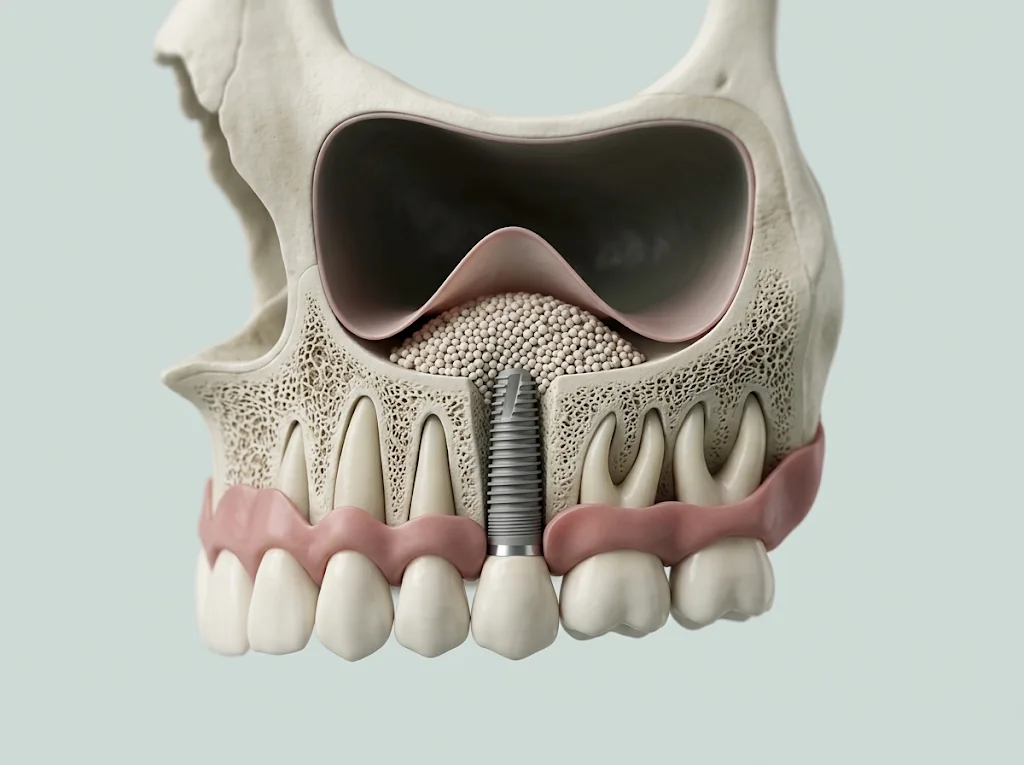
Above the roots of the upper back teeth sits the maxillary sinus, an air-filled space. When those teeth are lost, the bone below the sinus thins and sometimes isn't enough for an implant. A sinus lift raises the membrane on the sinus floor and makes room for new bone. Before I suggest one, I measure on the CT scan how much bone there is and whether it's truly needed: sometimes a short implant solves it without a graft.
After surgery, message me or call the office if you have a fever, pain or swelling that gets worse, a nosebleed that won't stop, pus, or liquid coming out of your nose when you drink. If you can't reach me, go to the emergency room.
- Imaging
- 3D CT scan (CBCT)
- Anesthesia
- Local, with sedation if needed
- Technique
- Crestal or lateral window, depending on bone
- Implant
- Same surgery or a second stage
When it's indicated
- You want an implant in an upper molar or premolar and the CT scan shows there isn't enough bone height for a standard-length implant.
- You lost those teeth years ago and the bone below the sinus has been thinning.
- A short implant isn't a good fit for your case, because of how little bone is left or where the tooth sits.
- Your sinus is healthy; if there is active sinusitis, it's treated first.
Before surgery
- If you already have a recent CT scan, bring it or send it ahead: it saves time and sometimes a repeat scan.
- Tell me about your medications and conditions, especially diabetes, blood thinners or osteoporosis treatments.
- If you smoke, stop: smoking is linked to more membrane perforations and lower implant survival after a sinus lift.
- If you have sinusitis, congestion or a cold close to the date, let me know so we can treat it or reschedule.
- If you're having sedation, come with someone and fast per the written instructions.
How I plan it
How I do it
- 01AnesthesiaLocal and, if you prefer or the case calls for it, sedation. The anesthesia prevents pain during the surgery.
- 02Crestal approachWith enough bone, I work through the implant site itself, gently push the sinus floor upward, with or without graft, and place the implant.
- 03Lateral windowWith less bone, I open a small window in the wall of the upper jaw, lift the membrane and fill the space with graft. With less than 4 mm of bone, or if you smoke, covering it with a membrane is advised.
- 04Implant: now or laterIf the remaining bone holds it steady, it goes in during the same surgery; if not, after the graft matures. Long term, the two approaches showed no difference in implant loss.
- 05Closure and follow-upStitches, written instructions and a follow-up to check the wound.
Recovery
- First few days: swelling, sometimes a bruise on the cheek, a little bleeding from the nose or a blocked nose. Cold packs and taking it easy help.
- First few weeks: don't blow your nose hard, sneeze with your mouth open and avoid blowing forcefully. This protects the membrane and the graft.
- No flying or diving until I clear you at the follow-up: pressure changes push on the sinus.
- The usual is a preventive antibiotic and antiseptic rinses, plus pain medication. No smoking or straws, and chew on the other side.
- Months: the graft has to mature before the implant takes a load. How long depends on the case; I confirm it with an image, not the calendar.
- First year: of the implants lost after a lateral sinus lift, 59% are lost that year; those check-ups aren't skipped.
Risks and how I prevent them
- Membrane perforation
- On average it happens in about one in five sinus lifts; depending on technique and instrument, reported rates range from 3.8% (crestal approach) to 24% (lateral window with rotary burs). I prevent it by locating septa on the CT scan; if it happens, it's repaired in the same surgery with a collagen membrane or the graft is postponed.
- Sinusitis
- It was reported in 1.11% of patients. I only operate on a healthy sinus; if it appears, it's treated with medication and, if it persists, by an ENT specialist.
- Infection
- With the crestal approach it was reported in 0.8% of patients. The antibiotic and rinses help prevent it; if it affects the graft, the material is removed.
- Bleeding, blocked nose or vertigo
- Nosebleeds, a blocked nose, bruising and dizziness when changing position are also described. If they don't settle, message me.
- Implant loss
- With the crestal approach, 3-year survival was 92.8%. With a lateral window, 95.8% were still in place at 5–13 years (low certainty), and having less than 4 mm of bone or smoking reduced survival. If an implant is lost, it's removed and we reassess.
Other options
- Short implant
- With 4 to 9 mm of bone, at one year it's unclear whether a sinus lift works better or worse than a short implant (5 to 8.5 mm), and sinus lifts had more complications. With implants of 6 mm or less, results were comparable for the first 5 years; at 5 years the trend favored a regular implant with a graft, without being significant.
- Pterygoid or zygomatic implants
- With very little bone, there are implants anchored behind the last molar (pterygoid) or in the cheekbone (zygomatic) that avoid large grafts, with their own indications and risks.
- Bridge or removable denture
- They replace the tooth without sinus surgery, with other drawbacks for the neighboring teeth or for comfort.
- Not replacing the tooth
- If the missing tooth doesn't affect your bite or bother you, that's also a valid choice. If surgery isn't needed, I'll tell you.
Frequently asked questions
When is a sinus lift needed?
When the bone below the sinus isn't enough for a standard-length implant. I measure it on the CT scan; sometimes a short implant avoids it.
Which is better, the crestal or the lateral window technique?
Neither is superior overall: in the trials that compared them, neither reduced failures more than the other. I choose based on the millimeters of bone and the shape of the sinus.
What graft is used? Is my own bone better?
It can be human donor bone, animal-derived, synthetic or your own bone. There's no evidence that your own bone is superior to substitutes, and taking it adds a second wound (from the chin it caused considerable discomfort). If you'd rather avoid animal or human materials, there are synthetic ones. I've given talks on bone biology (Tegucigalpa, 2018) and maxillo-mandibular reconstruction (AO CMF course, San José, 2014).
How many months until the implant?
If there's stability, it goes in during the same surgery. If not, a few months: I don't give a fixed number because it depends on the bone and the technique, and I confirm it with an image.
Can I get sinusitis?
It's uncommon: it was reported in 1.11% of patients, and I only operate on a healthy sinus.
Does a sinus lift hurt?
During surgery, the anesthesia prevents pain. Afterward there's swelling and discomfort for a few days, managed with medication.
When can I fly or dive?
When I clear you at the follow-up. If you have a trip planned, tell me before we schedule.
How much does a sinus lift cost?
It depends on the technique, the graft and how many implants are involved: I give you a quote after seeing your CT scan. A consultation is 60,000 colones and a video consultation 20,000, and in it we can review a CT scan you already have.
Sources
- 1.Tyndall DA et al. — Position statement of the American Academy of Oral and Maxillofacial Radiology on selection criteria for the use of radiology in dental implantology with emphasis on cone beam computed tomography. Oral Surg Oral Med Oral Pathol Oral Radiol, 2012.
- 2.Liu Y et al. — Incidence and Associated Factors of Schneiderian Membrane Perforation in Maxillary Sinus Floor Elevation: A Meta-Analysis. Int Dent J, 2026.
- 3.Jordi C et al. — Membrane perforation rate in lateral maxillary sinus floor augmentation using conventional rotating instruments and piezoelectric device-a meta-analysis. Int J Implant Dent, 2018.
- 4.Pjetursson BE, Lang NP — Sinus floor elevation utilizing the transalveolar approach. Periodontol 2000, 2014.
- 5.Raghoebar GM et al. — Long-term effectiveness of maxillary sinus floor augmentation: A systematic review and meta-analysis. J Clin Periodontol, 2019.
- 6.Sabri H et al. — Long-term outcomes of lateral sinus floor elevation: A machine-learning analysis, systematic review, and meta-analysis of predictive factors. Periodontol 2000, 2026.
- 7.Esposito M et al. — Interventions for replacing missing teeth: augmentation procedures of the maxillary sinus. Cochrane Database Syst Rev, 2014.
- 8.Grunau O, Terheyden H — Lateral augmentation of the sinus floor followed by regular implants versus short implants in the vertically deficient posterior maxilla: a systematic review and timewise meta-analysis of randomized studies. Int J Oral Maxillofac Surg, 2023.
- 9.Rocha RS et al. — Comparison of sinusitis rate after sinus lift procedure and zygomatic implant surgery: a meta-analysis. Oral Maxillofac Surg, 2024.
- 10.Al-Nawas B, Schiegnitz E — Augmentation procedures using bone substitute materials or autogenous bone - a systematic review and meta-analysis. Eur J Oral Implantol, 2014.
- 11.Nkenke E, Neukam FW — Autogenous bone harvesting and grafting in advanced jaw resorption: morbidity, resorption and implant survival. Eur J Oral Implantol, 2014.
- 12.Moraschini V et al. — Survival and complications of zygomatic implants compared to conventional implants reported in longitudinal studies with a follow-up period of at least 5 years: A systematic review and meta-analysis. Clin Implant Dent Relat Res, 2023.
- 13.Gianfreda F et al. — Indications, Techniques and Complications Associated With Pterygoid Implants: A Systematic Review and Meta-Analysis. Clin Implant Dent Relat Res, 2026.
Reviews from my patients (not necessarily about this procedure)
«Desde que entramos al área de parqueo se siente la seguridad y confianza, la recepcionista muy amable y simpática, poco antes de la hora de la cita nos avisan que había un pequeño atraso por una complicación con el paciente que tenía el Dr. Torres en ese momento la espera no fue larga y de todos modos el área de espera es muy amplia y agradable, El Dr. Torres muy amable y profesional en todo momento, no escatimó tiempo para dar una amplia explicación del procedimiento, en general mi esposa y yo nos sentimos muy cómodos y sobretodo con mucha confianza de estar en las manos adecuadas.Definitivamente 100% recomendados !»«El Doctor Ronald Torres es un excelente profesional. Lo recomiendo 100%. Su trato siempre ha sido amable, cortes, profesional. Se interesa en comprender la necesidad del paciente, y en todo momento trata que este comprenda bien los alcances del procedimiento a realizar. Ya me ha extraido dos cordales, y puedo decir que me fue muy bien. Puede tener confianza de buscar al Dr. Ronald, que le aseguro quedara satisfecho con su atencion.»«Excelente profesional, impecable en la técnica de su especialidad y con un trato humano digno de resaltar. Desde el día uno nos sentimos cómodos con él y esto se mantuvo y se ha mantenido hasta el día de hoy, en donde estamos ya con citas de mero seguimiento. La intervención quirúrgica realizada fue un éxito y el costo muy razonable. La verdad que gracias a Dios tomamos una excelente decisión con él. Súper recomendado.»«Mi hijo Luis Guillermo se realizó una cirugía maxilofacial con el doctor Torres y su equipo, el resultado fue y es a hoy excelente, recibió un servicio excelente de seguimiento después de su cirugía.Le cambió mucho la vida a mi hijo de forma positiva , una gran inyección de seguridad y autoestima.Como padres nos sentimos muy agradecidos y es de esas inversiones que valen la pena .»Other procedures
- 01Wisdom teeth surgery
- 02Dental implants
- 03All-on-4 immediate full arch
- 04Orthognathic surgery
- 06TMJ treatment and surgery
- 07Facial trauma
- 08Jaw cysts and tumors
- 09Buccal fat removal
- 10Extractions and abscesses
- 11Bone grafting and socket preservation
- 12Oral lesions and biopsy
- 13Zygomatic implants
- 14Video consultation and second opinion