06 · Oral & maxillofacial surgery
TMJ disorders: treatment, and when to operate
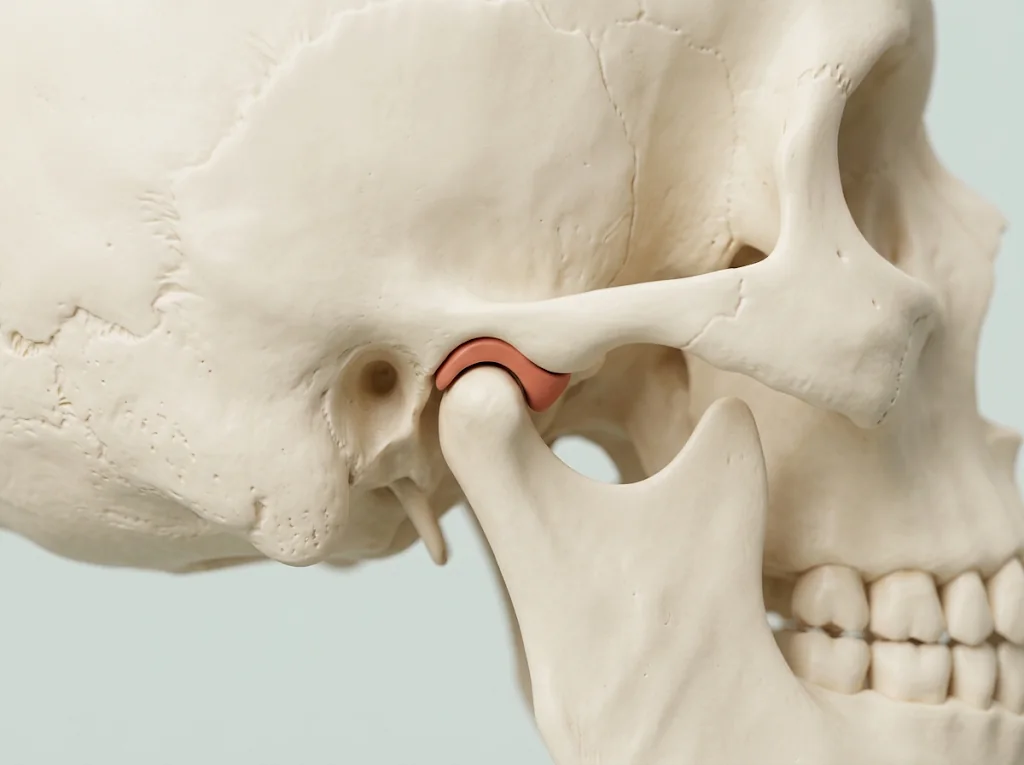
The TMJ — the temporomandibular joint — lets you open, close and move your jaw. TMJ disorders are the second most common chronic musculoskeletal pain condition after low back pain, affecting 6–9% of adults. Most are treated without surgery. So I first measure what hurts and why, and I'll tell you just as clearly when to operate and when not to.
If your jaw is stuck open and you can't close your mouth, contact the office or go to the emergency room. If jaw pain comes with chest pain, shortness of breath or a cold sweat, go to the emergency room right away: it may be your heart, not your TMJ.
- First step
- Conservative, reversible care
- Diagnosis
- History and exam; imaging if it changes the plan
- Surgery
- For a minority of cases
- Consultation
- 60,000 colones · video visit 20,000 colones
When it's indicated
- Pain in front of the ear, in the jaw or at the temples that won't ease.
- Painful clicking, or a jaw that catches when you open.
- Suddenly not being able to open all the way (a locked jaw).
- A jaw that slips out and is hard to close, or slips out often (dislocation).
- Bruxism — clenching or grinding your teeth — with pain or a tired jaw when you chew.
- Opening that gets more limited over the months, or unexplained changes in your bite.
Before surgery
- Write down when it started, what makes it worse (chewing, yawning, stress) and whether you wake up with a tired jaw.
- Bring any previous imaging and your splint if you wear one. If you don't, message me first: I'll tell you whether you need any.
- Note what you've already tried — splint, physical therapy, medication — and for how long.
- If you live far away, you can start with a video visit: in a small study (16 people), a video exam agreed well with the reference exam for identifying muscle and joint pain.
How I plan it
How I do it
- 01DiagnosisI explain what hurts — muscle, joint or both — and what to expect from each option.
- 02Self-careA soft diet during flare-ups, heat, not opening too wide and relaxing your jaw during the day. Current recommendations are to base treatment mainly on this.
- 03Physical therapy and pain managementMobilization by a physical therapist, supervised exercises, manual therapy and, if the pain is chronic, cognitive behavioral therapy: for pain lasting 3 months or more, the international guideline strongly recommends them. A splint can be added, and works better with exercise than alone.
- 04ArthrocentesisIf a painful lock or limited opening doesn't improve, the joint is washed out through fine needles, under local anesthesia, as an outpatient procedure. It isn't a first step: the evidence doesn't strongly support it, and for chronic pain in general the international guideline makes a conditional recommendation against it. Done within the first 3 months of conservative care, it may give good results.
- 05Arthroscopy or open surgeryFor selected cases: ankylosis (a fused joint), dislocation that keeps happening, tumors or advanced joint destruction. It's done in an operating room under general anesthesia; for disc problems it shouldn't be the first treatment.
Recovery
- Conservative care is judged over weeks to months; at each follow-up I measure opening and pain again.
- After arthrocentesis: mild discomfort for a few days, a soft diet and opening exercises from the start.
- Relief can take time: in one review, joint lavage showed less pain than conservative care at 3 and 6 months, but not at 1 month.
- Sometimes it needs repeating: one review suggests 3 to 5 arthrocentesis sessions work better than one.
- After open surgery, recovery takes weeks to months, with physical therapy to regain your opening.
- Physical therapy and home exercises continue after any procedure.
Risks and how I prevent them
- Overtreatment
- Grinding down teeth, changing the bite or using splints that alter it are not recommended for TMJ disorders. I prevent this by always starting with reversible care.
- Discomfort after arthrocentesis
- Soreness at the needle sites, swelling in front of the ear and, from the anesthetic, temporary weakness of some facial muscles. It's managed with cold packs, pain relievers and follow-up. Compared with arthroscopy, its complication rate was no different.
- It may not help
- In a double-blind trial of 60 patients with limited opening and joint pain, all groups improved, with no difference between arthrocentesis and conservative care. If there's no improvement, I review the diagnosis before going further.
- Risks of open surgery
- It can affect branches of the facial nerve (forehead and eyelid), sensation in front of the ear or the bite, and it carries a risk of infection. It's prevented by planning with a CT scan, protecting the nerve and close follow-up.
Other options
- Not operating: self-care and time
- A valid choice in many cases. Most people without severe psychosocial impairment tend to improve even without active treatment, and about 70 in 100 internal joint conditions stay stable.
- Physical therapy and cognitive behavioral therapy
- For chronic pain, compared with placebo, about 36 more people in 100 noticed pain relief with mobilization by a physical therapist or with cognitive behavioral therapy plus biofeedback or relaxation, and 32 more in 100 with manual trigger-point therapy.
- Stabilization splint
- Reversible, but its effect is uncertain: the Cochrane review (57 studies, 2,846 participants) found insufficient evidence to know whether it works. In another review, adding exercise worked better than the splint alone.
Frequently asked questions
Do most TMJ problems need surgery?
No. Surgery is reserved for a minority of cases, and most of those can be managed with minimally invasive techniques such as arthrocentesis.
Does TMJ pain go away on its own?
It often improves over time, even without active treatment. If it hurts, limits your opening or gets worse, it's worth an assessment.
Which TMJ treatment works best?
There isn't one for everyone. For pain lasting 3 months or more, the international guideline strongly recommends cognitive behavioral therapy, physical therapy, supervised exercises and home care. We combine them based on your diagnosis.
Does a splint help with bruxism?
It protects your teeth from wear, but its effect on TMJ pain is uncertain: in 13 trials (1,076 participants) there was no evidence that splints reduce pain when all disorders are analyzed together. It must be reversible.
My jaw clicks but doesn't hurt — do I need surgery?
No. Clicking that doesn't hurt or lock usually doesn't need surgery. One assessment tells you which signs to watch for.
My jaw locked — what should I do?
If it's stuck open and you can't close, contact the office or go to the emergency room. If it locked closed, message me soon: we start with conservative care and, if it doesn't improve, arthrocentesis is an option.
Is TMJ surgery risky?
Arthrocentesis is an outpatient procedure and the discomfort is usually mild and temporary. Open surgery carries risks to the facial nerve and the bite, which is why, for disc problems, it doesn't come first.
When should I see a dentist, a physical therapist or an oral surgeon?
Your dentist checks your teeth and bite; a physical therapist works on movement and muscle pain. See an oral and maxillofacial surgeon if your jaw locks or dislocates, if there's a change in the bone, or if it doesn't improve with initial treatment.
Sources
- 1.Busse JW et al. — Management of chronic pain associated with temporomandibular disorders: a clinical practice guideline. BMJ, 2023.
- 2.Yao L et al. — Management of chronic pain secondary to temporomandibular disorders: a systematic review and network meta-analysis of randomised trials. BMJ, 2023.
- 3.AADOCR — Temporomandibular Disorders (TMDs) Position Statement. American Association for Dental, Oral, and Craniofacial Research, 2026.
- 4.Riley P et al. — Oral splints for temporomandibular disorder or bruxism: a systematic review. Br Dent J, 2020.
- 5.Singh BP et al. — Occlusal interventions for managing temporomandibular disorders. Cochrane Database Syst Rev, 2024.
- 6.Idáñez-Robles AM et al. — Exercise therapy improves pain and mouth opening in temporomandibular disorders: A systematic review with meta-analysis. Clin Rehabil, 2023.
- 7.Hu Y et al. — Arthrocentesis vs conservative therapy for the management of TMJ disorders: A systematic review and meta-analysis. J Stomatol Oral Maxillofac Surg, 2023.
- 8.Li DTS et al. — Timing of arthrocentesis in the management of temporomandibular disorders: an integrative review and meta-analysis. Int J Oral Maxillofac Surg, 2021.
- 9.Ritto FG et al. — Arthrocentesis versus nonsurgical methods in the management of temporomandibular joint closed lock and pain: a double-blind randomized controlled trial. Oral Surg Oral Med Oral Pathol Oral Radiol, 2022.
- 10.Guarda-Nardini L et al. — Arthrocentesis of the Temporomandibular Joint: Systematic Review and Clinical Implications of Research Findings. J Oral Facial Pain Headache, 2021.
- 11.Bouchard C et al. — Temporomandibular Lavage Versus Nonsurgical Treatments for Temporomandibular Disorders: A Systematic Review and Meta-Analysis. J Oral Maxillofac Surg, 2017.
- 12.Tang YH et al. — Arthroscopy versus arthrocentesis and versus conservative treatments for temporomandibular joint disorders: a systematic review with meta-analysis and trial sequential analysis. Int J Oral Maxillofac Surg, 2024.
- 13.Rodhen RM et al. — Invasive surgical procedures for the management of internal derangement of the temporomandibular joint: a systematic review and meta-analysis regarding the effects on pain and jaw mobility. Clin Oral Investig, 2022.
- 14.Exposto FG et al. — Remote physical examination for temporomandibular disorders. Pain, 2022.
Reviews that mention this procedure
«Excelente profesional. El doctor Torres Labardini me explicó de forma clara las particularidades del trastorno temporomandibular, así como posibles tratamientos.»
Other procedures
- 01Wisdom teeth surgery
- 02Dental implants
- 03All-on-4 immediate full arch
- 04Orthognathic surgery
- 05Sinus lift
- 07Facial trauma
- 08Jaw cysts and tumors
- 09Buccal fat removal
- 10Extractions and abscesses
- 11Bone grafting and socket preservation
- 12Oral lesions and biopsy
- 13Zygomatic implants
- 14Video consultation and second opinion