 Dr. Ronald Torres Labardini ·
Before surgery: what I check
The European Federation of Periodontology clinical guideline is clear: preventing problems around an implant starts when it's planned, not when they show up. So before surgery I check four things.
- A 3D scan (CBCT) of the site. The American Academy of Oral and Maxillofacial Radiology recommends assessing every implant site with 3D imaging and names CBCT the method of choice: it shows the available bone and the structures nearby.
- Your gums. Periodontitis (gum disease) is one of the risk indicators for peri-implantitis, so it's treated first.
- Your blood sugar, if you have diabetes or might have it. A review recommends measuring HbA1c when planning implants, so control can be adjusted before surgery.
- Your medications, your allergies and tobacco. If you smoke, this is a good time to quit; I explain why below.
Stage by stage
- SurgeryI work with local anesthesia; sedation is considered depending on your case and how anxious you are. I prepare the site in the bone and place the implant, which is either covered by the gum or left with a healing abutment showing. If I prescribe a preventive antibiotic, there's evidence behind it: in the Cochrane review, under ordinary conditions, a single dose of amoxicillin one hour before surgery reduced implant failures. If you're allergic to penicillin, tell me beforehand. At home: rest with your head raised, cold packs on the outside and no vigorous rinsing.
- First 72 hThis is when pain control may matter most: in clinical trials, anti-inflammatory drugs reduced pain compared with placebo. Take what I prescribed on schedule. Swelling, a bruise and light bleeding are expected. Soft, cool food, chewing on the other side.
- Week 1Soft diet, gentle cleaning around the implant the way I show you, and no smoking. I see you for a check-up to review the wound and remove stitches if needed.
- Following monthsThe bone bonds to the implant. From the outside you barely notice anything, but this is the stage that determines whether the implant ends up firm. Don't bite hard on the area and, if you have a temporary tooth, treat it gently.
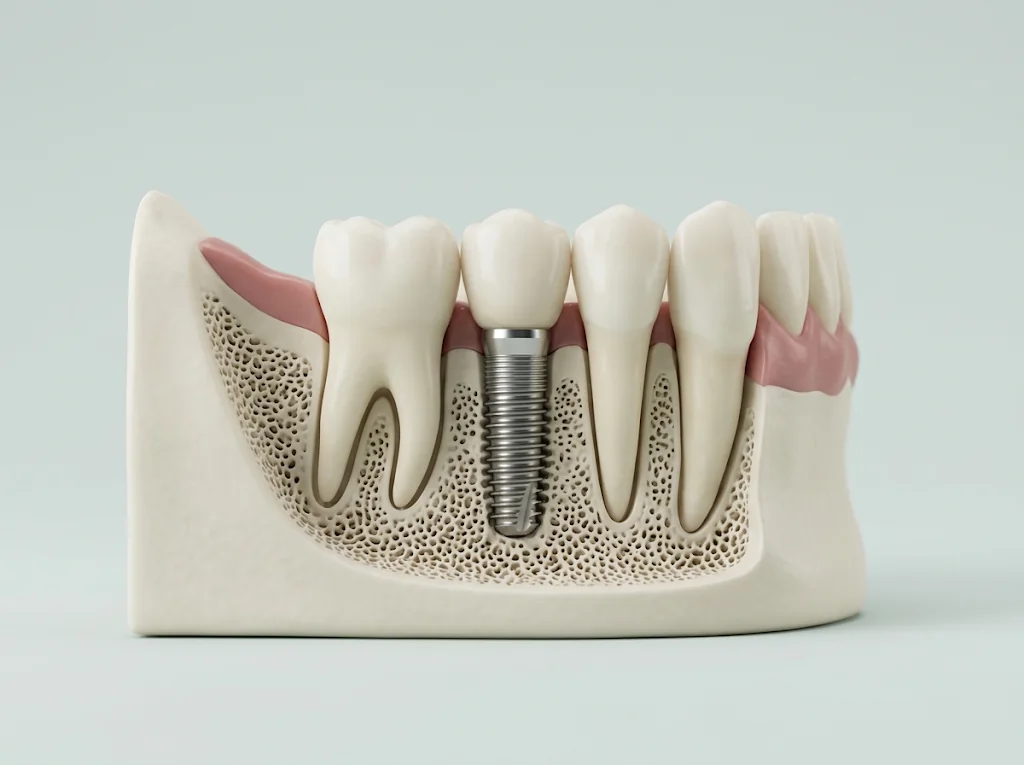
- CrownOnce I confirm the implant has integrated, the restorative part begins: an abutment is connected and the crown is made to fit your bite.
- Long termDaily cleaning, plus regular maintenance check-ups and cleanings. That's what protects the implant most over the years.
Integration: how long does it take?
Osseointegration is the name for something simple: bone grows tight against the implant's surface until it holds it, the way it used to hold the root. It doesn't hurt and you can't feel it, which is why it's easy to forget it's happening. Online you'll find calendars with a fixed month for every step; I won't give you one from a chart. The timing is measured in months, and I set it for your case based on your bone, whether there was a graft or sinus lift, and the stability I achieved at surgery. What is well studied is what puts integration at risk: in smokers, the risk of early failure (the implant not integrating) was double that of non-smokers, counted per patient, and the association was stronger in the upper jaw. If an implant doesn't integrate, I remove it, let the area heal and we consider placing a new one.
The crown: when it goes on and who makes it
The crown goes on once the implant has integrated, not before. Since 2013 my practice has been dedicated exclusively to oral and maxillofacial surgery: my part is placing the implant and confirming it's ready to take a load. The crown is made by your dentist or a prosthodontist.
- An abutment is connected: the piece that joins the implant to the crown.
- An impression or a scan is taken and the crown is made to fit your bite.
- In some cases a temporary tooth can be used in the meantime; it depends on the implant's stability and is decided case by case.
- Over the years, a screw can loosen or a part can wear or fracture. It's adjusted or repaired at check-ups: one more reason not to skip them.
Food, work and home care
- Food: soft and cool for the first few days (mashed potatoes, lukewarm soups, eggs, yogurt, refried beans). Then ease back to normal, without biting hard on the implant until I give you the go-ahead.
- Cleaning: brush the rest of your mouth as usual; around the implant, gently and the way I show you. Once you have the crown, clean it every day like any other tooth, with a brush and floss or interdental brushes.
- Tobacco: don't smoke while it heals and, if you can, don't go back. It's associated with more early failures and more peri-implantitis.
- Medication: what I prescribed, on schedule. Don't add others without checking with me.
- Work and exercise: it depends on how many implants I place and whether there's a graft. We talk about it before booking so you can plan ahead.
How to prevent peri-implantitis
An implant can't get a cavity, but the gum and bone around it can get sick. Mucositis is inflammation of the gum around the implant; peri-implantitis is inflammation with bone loss. Two large reviews found peri-implantitis in 21% and in 25.0% of patients. In the review that reported 25.0%, it appeared in 18.0% of implants overall and in 5.2% of implants in non-smokers. What prevents it most:
- Regular maintenance. People who attend check-ups and cleanings regularly have a lower risk of peri-implantitis than irregular attendees, and the risk of losing the implant appears higher without those visits. The European guideline recommends a maintenance program with periodic check-ups once the implant carries its tooth.
- Well-controlled diabetes. Well-controlled type 2 diabetes was not associated with more disease around the implant; among people with diabetes, those with good glucose control have a lower risk of peri-implantitis than those with poor control.
- Fewer risk factors. Periodontitis, diabetes, smoking and alcohol consumption were risk indicators for peri-implantitis: they're associations, not proven causes, but several are within your control.
- Watch for the signs. Bleeding when you brush around the implant, red or swollen gum, a bad taste or pus: message me. Caught early, it's managed with a deep cleaning; if it advances, it may need surgery.
How long does an implant last?
In studies followed for 10 to 25 years, approximately 95% of implants were still in place. At 10 years, the figure ranges from 93.2% to 96.4% depending on how the data are analyzed: the lower one accounts for people who stopped coming to check-ups. Two honest caveats: still being in place isn't the same as being healthy, and no average predicts what will happen with one particular implant. What does depend on you is maintenance.
When to message me or go to the ER
- Bleeding that won't stop with pressure on a gauze.
- Pain or swelling that increases after the first 72 hours instead of going down, or pain that doesn't ease with what I prescribed.
- Fever, pus or a persistent bad taste in the area.
- The implant, the healing abutment or the temporary tooth moves or comes loose.
- Numbness of the lip, chin or tongue that doesn't go away when the anesthesia wears off.
- If the implant is in the upper jaw: liquid passing into your nose when you drink, or a nosebleed that won't stop.
- Difficulty breathing or swallowing, or swelling that spreads quickly toward the eye or neck: go to the ER right away, without waiting for my reply.
Sources
- 1.Herrera D et al. — Prevention and treatment of peri-implant diseases-The EFP S3 level clinical practice guideline. J Clin Periodontol, 2023.
- 2.Tyndall DA et al. — Position statement of the American Academy of Oral and Maxillofacial Radiology on selection criteria for the use of radiology in dental implantology with emphasis on cone beam computed tomography. Oral Surg Oral Med Oral Pathol Oral Radiol, 2012.
- 3.Galarraga-Vinueza ME et al. — Prevalence, incidence, systemic, behavioral, and patient-related risk factors and indicators for peri-implant diseases: An AO/AAP systematic review and meta-analysis. J Periodontol, 2025.
- 4.Bencze B et al. — Prediabetes and poorly controlled type-2 diabetes as risk indicators for peri-implant diseases:A systematic review and meta-analysis. J Dent, 2024.
- 5.Esposito M et al. — Interventions for replacing missing teeth: antibiotics at dental implant placement to prevent complications. Cochrane Database Syst Rev, 2013.
- 6.Khouly I et al. — Post-operative pain management in dental implant surgery: a systematic review and meta-analysis of randomized clinical trials. Clin Oral Investig, 2021.
- 7.Fan YY et al. — Smoking in relation to early dental implant failure: A systematic review and meta-analysis. J Dent, 2024.
- 8.Reis INRD et al. — The prevalence of peri-implant mucositis and peri-implantitis based on the world workshop criteria: A systematic review and meta-analysis. J Dent, 2025.
- 9.Carra MC et al. — Primordial and primary prevention of peri-implant diseases: A systematic review and meta-analysis. J Clin Periodontol, 2023.
- 10.Moraschini V et al. — Ten years and beyond: Long-term dental implant survival, success, and biological health-A systematic review and meta-analysis. Periodontol 2000, 2026.
- 11.Howe MS et al. — Long-term (10-year) dental implant survival: A systematic review and sensitivity meta-analysis. J Dent, 2019.